

 You are here:
Frequently Asked Questions (FAQ)Toothbrush · Chenille · Specialty Embroidery
Answers to common questions about Toothbrush Embroidery, Chenille Embroidery, and specialty computerized embroidery
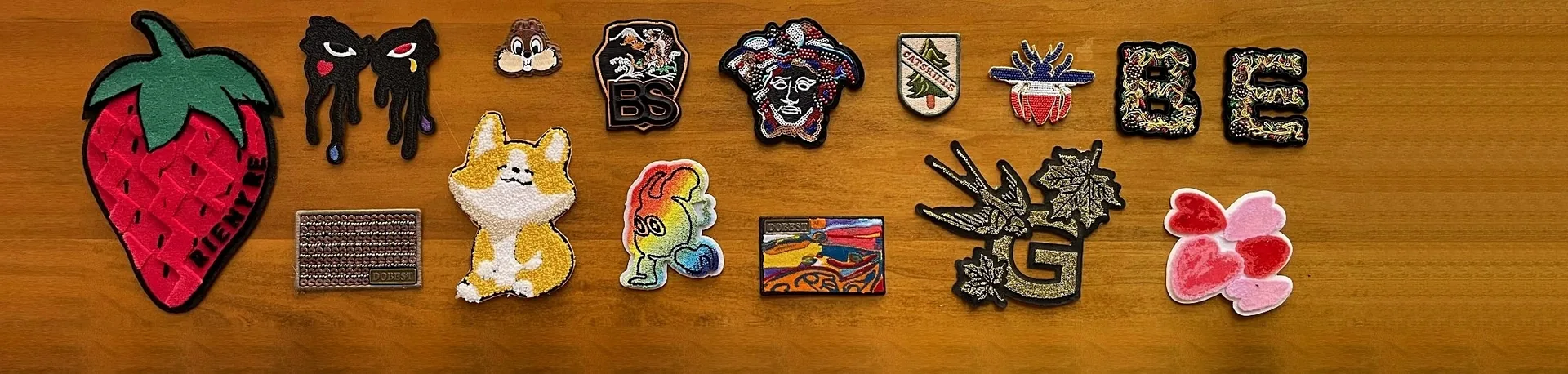
Dongguan Dobest Industrial Co., Ltd. has specialized in specialty computerized embroidery for 13 years, known for two signature techniques — Toothbrush Embroidery (Flocking / Turf / Vertical Pile / Tufting Embroidery) and Chenille Embroidery ("gau laang" / "gau mou" / "sau jiu" / Chain Stitch / Loop Embroidery) — while also offering a complete range of solutions including Backing-Free Embroidery, Flat Embroidery, Sequin Embroidery, Appliqué Embroidery, and Laser-Cut / Laser-Engraved Embroidery. Below are the questions customers ask most before sampling and ordering — answered once and clearly. If you have further questions, feel free to contact us directly.
Frequently Asked Questions
1. What is the difference between toothbrush embroidery and ordinary 3D embroidery?
Toothbrush embroidery is a three-dimensional embroidery technique that makes the thread stand upright, dense, and fluffy on the fabric surface like toothbrush bristles — hence the name. It is a high-difficulty subcategory within raised embroidery, also known as Flocking, Turf, Vertical Pile, or Tufting Embroidery.
Ordinary 3D embroidery usually refers to 3D foam or padded embroidery, which relies on padding to build up height; it tends to feel stiff and flatten over time. The key difference with toothbrush embroidery is that it "stands up on thread alone": the thread itself stands upright and fluffy, soft to the touch and breathable, with dimensionality coming from the thread and process parameters rather than a hard padding layer. To judge the quality of a toothbrush embroidery, focus on two things — whether it feels soft and whether it sheds after washing.
2. Why doesn't your toothbrush embroidery shed easily?
Because our thread is "locked" in, not "pressed" in.
A common industry approach is to pad thick felt on an ordinary flat embroidery machine: the top thread and bobbin thread interlace to form the pattern, adhesive is applied to the back, and the felt is trimmed. The adhesive can only bond to the bobbin thread, while the top thread barely adheres — so the thread is prone to loosening, feels stiff, and sheds after washing.
Dobest has rebuilt the key parts and control system of its embroidery machines in-house, using a single-sided direct threading + high-strength TPU heat-fused locking process: a single top thread travels repeatedly between the fabric and the felt, the back is fully bonded with TPU adhesive, and the excess felt and thread are trimmed away. The full-surface adhesive locks every thread firmly in place, so the finished product is soft, with upright pile, breathable and wash-resistant — and our internal defect rate has long stayed under 1%.
3. Can stretch fabric be embroidered?
Yes. Stretch fabric (including knitted stretch fabrics) used to be difficult to embroider: paper backing, heat-fused adhesive film, or water-soluble film each bring problems — paper residue irritates the skin, adhesive film peels off into sharp filaments, and water-soluble backing requires washing, which can change the fabric's size and slightly shift its color.
In 2026, Dobest developed and launched its Backing-Free Embroidery process: no paper or tear-away backing, no heat-fused adhesive film, no water-soluble film, no EVA — embroidery can be completed on a computerized embroidery machine with no backing at all. Even stretch fabric can be embroidered using thread alone, with a soft hand feel, strong dimensionality, and no skin irritation. If your stretch-fabric products keep running into the same problem — once embroidered, they become unwearable — send us the fabric and artwork for a process evaluation.
4. Do you support finished-garment embroidery? Can you handle small batches and multiple styles?
Yes. We can run finished-garment embroidery on ordinary embroidery machines, which is ideal for the quick-response model used by brands and livestream e-commerce: you only stock blank (unfinished) garments; once orders come in, embroidery is added by style, so you produce exactly what you sell and can turn blanks into new styles at any time — instant hot-item production with zero warehouse inventory and no risk of overstock.
Small batches and multiple styles are also welcome: send us the artwork for different styles and patterns together, and we can schedule production and deliver in batches by style. We recommend confirming the specific style counts and batch combinations during the process evaluation stage, so we can offer better unit pricing and lead times.
5. What is your minimum order quantity (MOQ)?
Our standard MOQ is 300 pieces. This allows sampling, machine setup, and process-parameter locking to be spread over a reasonable cost base, and keeps quality more stable during bulk production.
If your quantity is below 300 pieces, we are glad to review it case by case: if the project has ongoing reorder potential, or is at the new-product development sampling stage, we can assess it case by case. Our sampling policy is also flexible — simple designs can be sampled free of charge up to 3 styles; sampling fees for complex designs can be offset once a subsequent bulk order reaches the 300-piece MOQ.
6. Can you issue VAT special invoices? What are your company credentials?
Yes. Dobest is a general VAT taxpayer and can issue 13% VAT special invoices — suitable for brands and export companies with strict invoicing and financial-compliance requirements.
Other credentials: Grade A tax credit rating for four consecutive years (2021–2024); qualified for the import and export of goods and technology since November 2020; our embroidery threads are supplied with OEKO-TEX® Standard 100 and SGS test reports from our suppliers; the company has passed Disney factory audits (Disney ILS, International Labor Standards) and adidas SEA (Social & Environmental Affairs) audits, and holds 2 utility model patents and 6 registered trademarks, all available for verification.
7. Do you have export experience? How does export work?
Yes. Our products and services already cover China, Japan, Europe & North America, and Southeast Asia, and we have long supplied export trims and accessories buyers, trading houses, and cross-border e-commerce customers. We are familiar with the common export requirements for sample approval, packaging and labeling, lead-time coordination, and quality acceptance.
The company has held qualification for the import and export of goods and technology since November 2020, and can settle in RMB or foreign currency (per contract). We can also work with your designated forwarder and shipping method. For first-time cooperation, we recommend sampling first to confirm the technique and quality standards before bulk production and shipment. For projects with brand specifications or export testing requirements, we suggest defining test items and acceptance criteria at the sampling stage, so quality boundaries are locked before mass production.
8. Do you have any patents or trademarks?
Yes. The company holds 2 utility model patents and 6 registered trademarks, all owned by the company, with the 2 patents invented by legal representative Mr. Liu Ronghui:
① "A Re-Positionable 3D Soft Fabric Label", grant publication no. CN222896500U, granted May 23, 2025;
② "A 3D Calligraphy & Painting Craftwork", grant publication no. CN222780179U, granted April 22, 2025.
The registered trademarks include the word mark "德邦仕" and figurative marks in international classes 24, 26, and 35. All of the above authorization information can be provided with reference numbers for verification. For customers, this means independent process and structural know-how, and a clear, traceable origin for the technical solutions involved in cooperation.
9. What embroidery techniques can you do?
Beyond our two signature techniques — Toothbrush and Chenille Embroidery — we also provide Backing-Free Embroidery, Flat Embroidery, Sequin Embroidery (Sequin, Metallic Sequin), Appliqué Embroidery, Laser-Cut / Laser-Engraved Embroidery, Machine Beading, Cord & Braid Embroidery, Fringe Embroidery, Cross-Stitch Embroidery, Chunky Wool Machine Embroidery, Flat Metallic Thread Machine Embroidery, Needle-Fur / Brushed-Nap Embroidery, 3D Hollow Embroidery, 3D Foam & EVA Puff Embroidery, Wall Covering / Wall Mural Machine Embroidery, and more — a complete range of computerized embroidery solutions.
Each technique can be used on its own, or combined with others on a single product — for example, chenille combined with toothbrush, flat, sequin, or cord embroidery on one piece for multi-layered, multi-textured effects. If you have a more specialized need, send us the artwork or a physical sample and our process team will evaluate feasibility.
10. What are your sampling lead time, sampling fee policy, and bulk lead time?
Sampling: standard artwork is usually sampled within 24–48 hours; complex specialty composite patterns take about 3–4 working days.
Sampling fee policy: simple designs can be sampled free of charge up to 3 styles; complex designs incur a sampling fee, which can be offset against the order value once a subsequent bulk order reaches the 300-piece MOQ.
Bulk production: lead time is typically 5–10 working days. Rush orders can be scheduled with priority — please state your desired lead time when ordering, and we will give you a clear reply based on the current production schedule. All of the above lead times assume confirmed artwork, available fabric, and written sample approval.
11. Which regions do you serve?
Our factory is based in Humen, Dongguan, adjacent to Guangzhou, Shenzhen, Foshan and Zhongshan. We serve the entire Pearl River Delta, including Dongguan, Guangzhou, Shenzhen, Foshan, Zhongshan, Zhuhai, Huizhou, Shunde and Panyu, with on-site liaison, fast sampling and sample delivery. Delivery is usually same-day or next-day within the PRD; customers elsewhere in China and overseas can send and receive samples by courier.
12. Can you customize from a physical sample or a sketch if I do not have digitized embroidery files (.DST / .EMB) or vector artwork?
Yes. We work in three modes. Mode A - artwork-based customization: if you already have AI / PDF / CDR or high-resolution images, we handle digitizing and process set-up. Mode B - sample replication and upgrade: if you only have a physical garment, an existing patch or photos, we scan and measure it, then re-digitize, with the option to change colours, resize or upgrade to a backing-free construction. Mode C - concept co-creation: with only a hand sketch or reference image, our process team first advises on structure and stitchability, then moves to sampling. Standard artwork is sampled within 24-48 hours, with up to 3 simple samples free of sampling charge; complex or composite constructions take about 3-4 working days.
13. What is backing-free embroidery, and what are its advantages for material reduction and next-to-skin wear?
Backing-free embroidery forms the design directly on the cut panel or garment through tension control and a three-dimensional lock-stitch structure, without non-woven backing, water-soluble film or hot-melt paper backing. It removes backing material and the tearing-off step, cutting interlining waste and garment weight. The embroidered surface stays soft and breathable, so it feels less stiff against bare skin. It is commonly used on kidswear, close-fitting hoodies and T-shirts, loungewear and soft labels; suitability and wash performance are subject to sample confirmation, and kidswear orders are sourced according to the customer safety requirements and fabric test reports.
Any other questions? Ask us directly — it's the fastest way.
Send us your design artwork (AI / PDF / JPG), logo, target fabric, size, quantity, application, and lead-time requirements — we'll first run a process evaluation, then discuss pricing.
Related pages: About Us | Products | Toothbrush Embroidery | Chenille Embroidery | Backing-Free Embroidery | Contact Us
Dongguan Dobest Industrial Co., Ltd. | Phone / WeChat: 13712297700
Last updated: October 2026
 2/F, Bldg E, Jinmao Xincheng, No.7 Jiedong South Rd, Xiaojiejiao, Humen, Dongguan, Guangdong, China
 mclau@dobest.hk