

 You are here:
What Is Tassel Embroidery? Process Principles, Fringe Length Specifications, and Selection Guide
 Release time:2026-10-16
 Views:
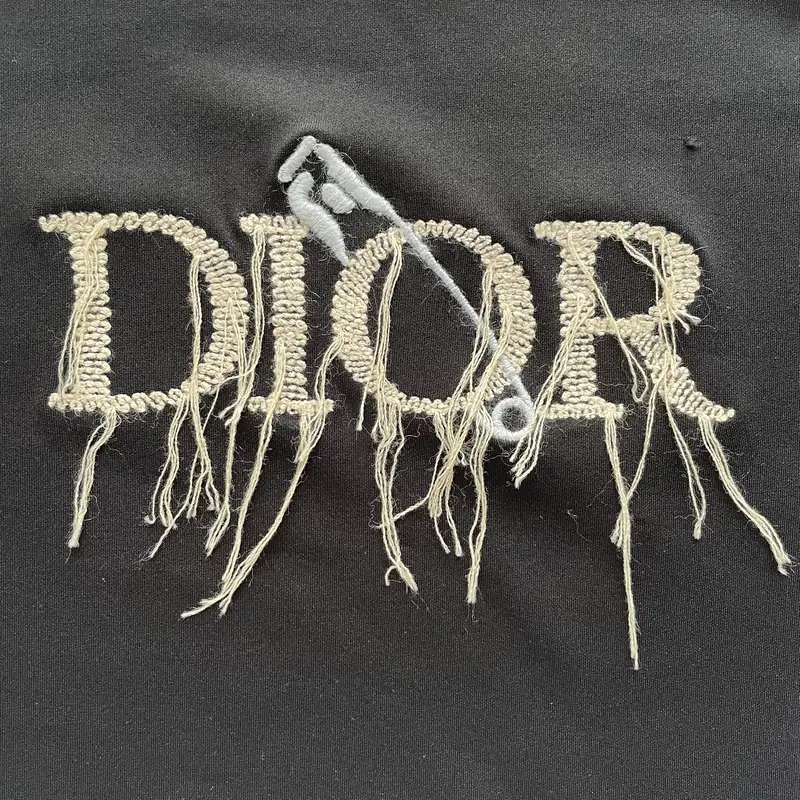
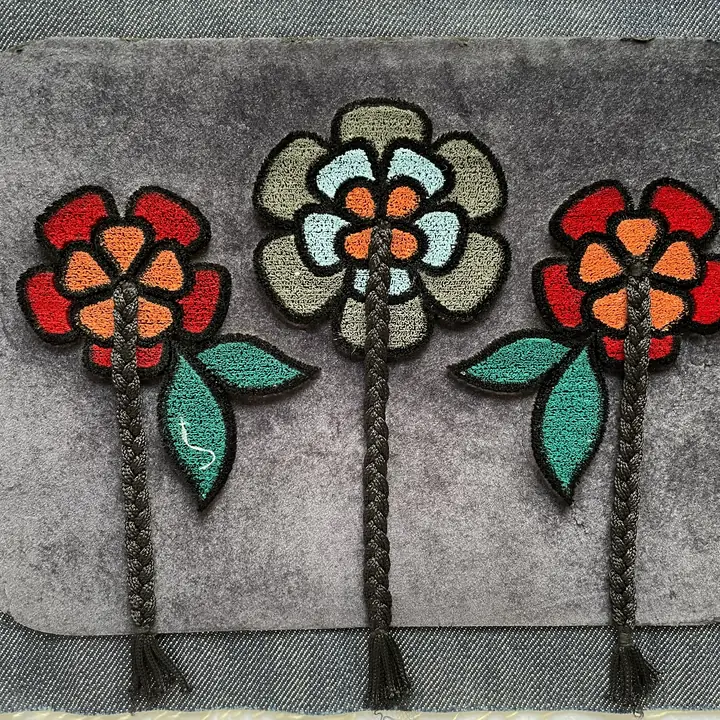
【Core Definition and Quick Selection】Tassel embroidery (Tassel / Fringe Embroidery; also called fringe embroidery, tassel trim, fringe trim embroidery, or tassel lace) is a dynamic fringe embroidery made by arranging loops to secure the roots and then precisely cutting the bobbin thread, so the tail ends hang naturally and swing with movement. Materials are mainly rayon, polyester, cotton thread, and metallic-luster thread. The roots are securely locked, and the threads are lively and flowing. Standard tassel length is 10–50 mm, MOQ 300 pcs, simple samples: 3 styles free of charge, standard sampling: 24–48 hours, bulk production: 5–10 working days. Suitable for skirt hems, shawls and scarves, ethnic-style apparel, and fashion bags.
I. In One Sentence
Tassel embroidery is a decorative embroidery that “makes embroidery move”: the embroidery thread is densely locked at the root, while the tail ends are left as free-hanging thread ends. When a person moves or the wind blows, the tassels swing naturally—a dynamic effect that static techniques such as flat embroidery and chenille embroidery cannot achieve.
Traditional embroidery pursues “close-fitting, flat, and three-dimensional” effects, while tassel embroidery does the opposite, deliberately retaining hanging free thread tails so that flat fabric gains real depth and movement. At rest, it is a neat row of hanging tassels; when walking, it ripples like waves. It is a signature element in bohemian, new Chinese style, Western cowboy, and music-festival styles.
Ordinary flat embroidery “stitches the pattern fixed onto the fabric”; tassel embroidery “leaves the thread on the fabric and lets it come alive.”
II. Common Names and Terminology Distinctions (Important: Don’t Get Confused by the Names)
In apparel sourcing and export communication, “tassel” has various trade terms and names. The core is the same structure, while the naming sources emphasize different aspects:
| Industry Term | English Equivalent | Naming Source and Focus |
|---|---|---|
| tassel embroidery | Tassel Embroidery | Main name; emphasizes the finished form of “tassel-like hanging and swingable.” |
| fringe embroidery / tassel embroidery | Fringe Embroidery | Common folk name; named from the visual impression of “tassels/fringe.” |
| fringe trim embroidery / tassel lace | Cut-loop Fringe / Fringe Trim | Emphasizes rows of fringe trim, often seen on home textiles and bag edges. |
| machine tassel embroidery | Machine Tassel | Distinguishes from handmade tassels; emphasizes batch and consistent production by computerized embroidery machines. |
Craft boundaries that must be clarified:
- Cut-loop Fringe ≠ Closed-loop Tassel: The former cuts open looped coils to obtain bundles of separated filaments; it is flowing but more prone to snagging. The latter retains complete circular loops, feels rounded, is wear-resistant, and less likely to fuzz, but has slightly weaker flow. The two have different characters and different quotations.
- Tassel embroidery ≠ toothbrush embroidery: toothbrush embroidery has pile standing upward and forms main block areas; tassel embroidery has pile hanging downward and serves as edge decoration. One is “upright,” the other “hanging”—the material selection logic is completely opposite.
- Tassel embroidery ≠ hand-woven tassels: machine-embroidered tassels are numerically formed on computerized embroidery machines according to preset loop lengths and are batch-consistent; handmade tassels are wound and knotted bundle by bundle, with strong grain but consistency dependent on manual work.
III. Principle and Forming Technology: How Is It Made?
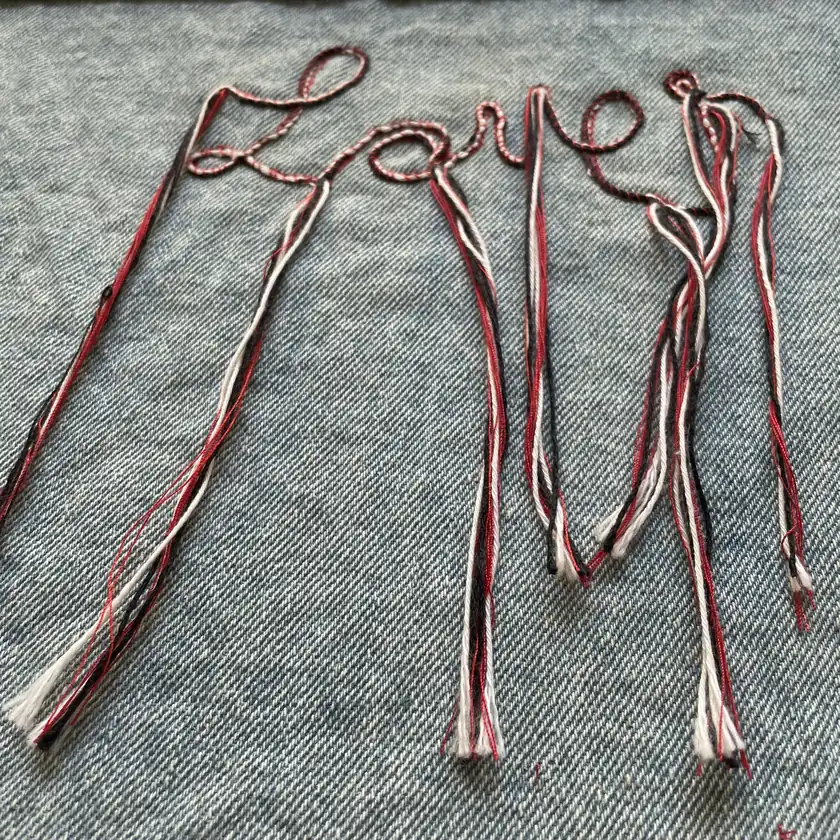
The basic structure of tassel embroidery is “fixing point + free end”: the embroidery thread is concentrated and fixed at an anchor point (usually reinforced with dense fixing stitches or backstitch locks), and a certain length of thread ends is left outside the anchor point without cutting, allowing them to hang freely and form tassels. According to the forming route, there are mainly three types:
- Stitch and cut into tassels: On the embroidery machine, thread is densely stitched along a baseline at a preset length, then the loops are cut to form pile tassels; tassel length is precisely controlled by loop length, and fullness is controlled by density—this is the most conventional machine-embroidery method.
- Bundle fixing: Several threads are gathered into a bundle, fixed at the middle with dense stitches or bound tightly with wrapping thread, with both ends free, producing “bundle-by-bundle” tassels with stronger grain and closer to traditional handmade tassels.
- Independent tassel trim plus sewing: Independent tassel trims are first embroidered on the machine and then sewn or bonded to the main body, facilitating batch production and drape control.
Two technical difficulties:
- Root pull-out prevention: Tassels may be pulled by external force; if the anchor point is not firm, the whole bundle can be pulled out. In digitizing, dense backstitch locks are designed at the rooting position of each thread bundle to form load-bearing anchor points, and pull tests are performed bundle by bundle.
- Anti-static and anti-tangling: After fiber opening, long tassels are prone to mutual attraction and tangling due to static electricity in dry environments; micro-steam softening finishing and combing are required, followed by fixed-length trimming.
IV. Effect Specifications (Conventional Capability Range)
| Process Control Item | Standard Capability Specification | Design and Engineering Notes |
|---|---|---|
| Common tassel length | CNC-programmed within the 10–50 mm range | 20–35 mm is the least prone to tangling and is the most commonly used range; longer tassels place greater load on the anchor point and increase snagging and packing costs. |
| Length tolerance | Controlled by fixed-length trimming | Manual combing and fixed-length trimming keep the overall appearance largely consistent. |
| Form options | Rounded looped ends / cut open ends available | Choose according to style and durability requirements: cut ends for a flowing look, looped ends for abrasion resistance. |
| Common threads | Rayon, polyester, cotton, metallic-luster thread | Drape is the key material-selection criterion; tassels should hang softly rather than feel stiff. |
| Suitable substrates | Satin ribbon, webbing, heavyweight fabric, leather, decorative base fabric | The anchor point bears concentrated tension, so the substrate needs sufficient strength. |
| Colorfastness requirements | Dark and vivid colors require upfront rub-fastness and light-fastness testing | Tassels have a large surface area, high exposure and constant movement, so requirements are higher than for standard embroidery. |
| Care and weather resistance | Hand wash and gentle handling recommended; avoid machine washing and snagging on sharp objects | Hang in the shade to dry after washing so tassels hang naturally and smoothly. |
V. Hand Feel and Visual Appearance: Where Its Strengths Lie (Weighing Pros & Cons)
Core advantages (Pros):
- Dynamic visual impact: It hangs neatly when still and sways in waves when moving—a “living” effect that flat embroidery and chenille embroidery cannot deliver, and a rare process among the fifteen process categories that wins through movement.
- Hand-finished drape: Well-made tassels hang smoothly, form natural curves and do not tangle; when brushed with the hand, they swing smoothly rather than knotting, which directly reflects the finishing work.
- Style signature and commercial premium: It is an iconic element in Bohemian, New Chinese, Western cowboy, music-festival and similar styles, making it easy to create differentiation and improve product memorability.
Process boundaries and physical limitations (Cons):
- Inherently susceptible to snagging and tangling: This is a product characteristic rather than a quality defect. Avoid sharp objects, stiff belts, backpack zippers and high-friction environments; proactively include this in care and packaging recommendations before delivery.
- High manual finishing cost: Fringe cutting, combing, trimming and setting cannot be replaced by machines; unit prices are not directly comparable with standard embroidery and should be accurately accounted for in quotations.
VI. Suitable Fabrics and Application Guide (Garment Placement Guide)
Common garment placement areas and recommended sizes:
- Women’s wear/evening dress hem tassel trim: Applied in rows, with tassel length of 5–15 cm, creating wave movement when walking.
- Shoulder and cuff decoration: Short tassel accents, restrained and refined.
- Edges of shawls, scarves and belts: Draped trim that highlights resort and ethnic styles.
- Handbag sides, shoe uppers, hat brims: Small-area tassel accents to enhance trend appeal.
Recommended substrates: Satin ribbon, webbing, heavyweight fabric, leather, decorative base fabric; in home textiles, also commonly seen on the four edges of cushions, curtains, tablecloths and decorative wall hangings.
Not suitable for: Next-to-skin products for young children, everyday garments requiring frequent machine washing, work environments with frequent contact with sharp objects or high friction, and projects highly sensitive to transport and storage costs.
VII. Variants and Combined Processes (One Design Can Use Multiple Processes at the Same Time)
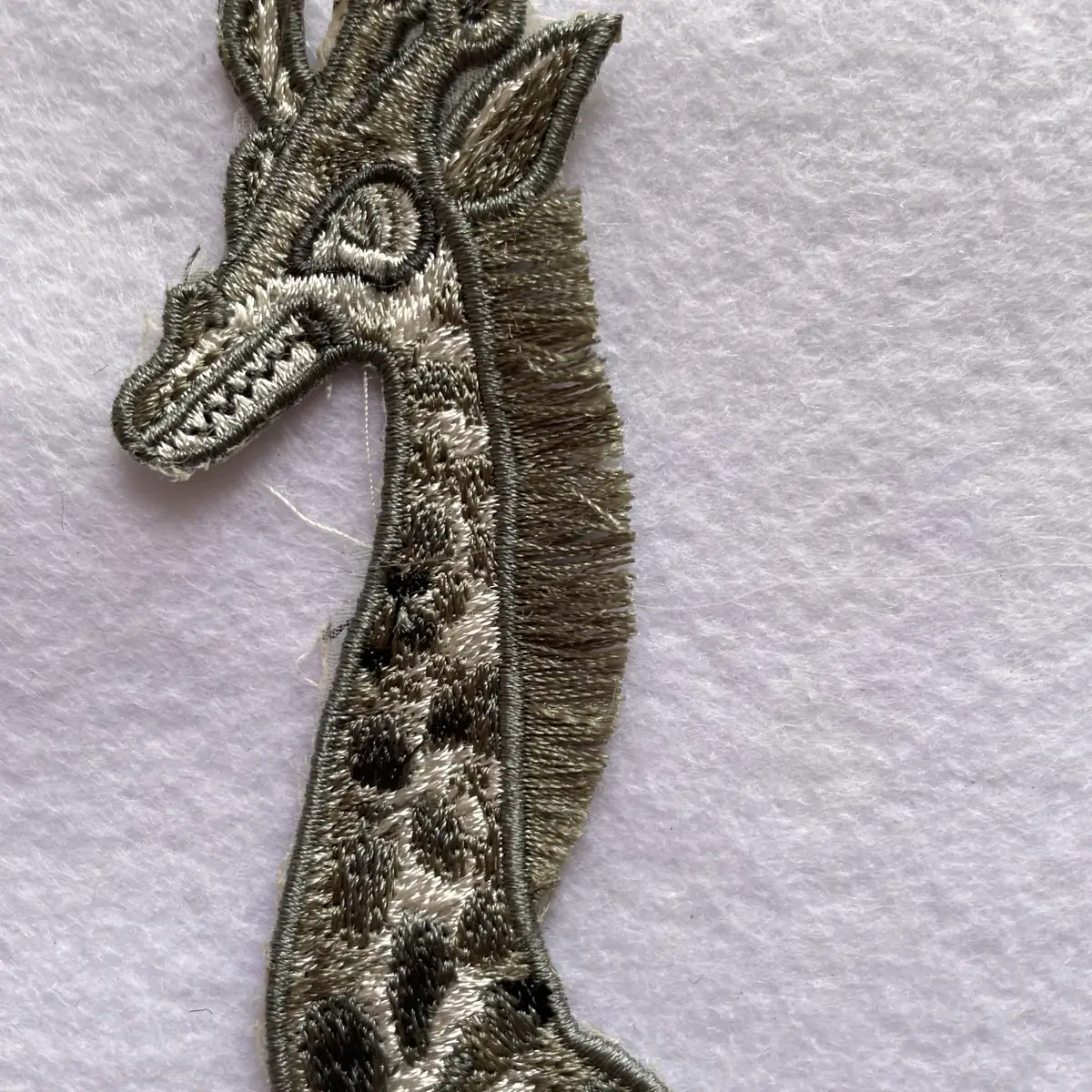
Tassels can be used alone as trim or as accents combined with other processes to create richer layered effects:
- Main body flat embroidery/chenille embroidery + tassel edge trim: Use flat embroidery or chenille embroidery for the main motif and add tassels at the edges, balancing solid areas with movement.
- Sequin embroidery + tassel accents: Add tassels to a sequin base to create a glamorous stage effect.
- Cross-stitch geometric patterns + local tassel accents: A classic pairing on ethnic and resort-style products; geometric patterns with local tassel accents stand out well.
- Metallic-luster long tassels + sequin combination: Use metallic-luster thread for long tassels and pair with sequins, suitable for stage costumes and art installations.
VIII. Selection Comparison Table (Choose at a Glance)
| Technique Category | Dimensional and Texture Form | Hand Feel | Minimum Line Width | Recommended Style Applications | Relative Cost |
|---|---|---|---|---|---|
| Tassel embroidery | Hanging tassel form, swingable | Drapey, flowing, dynamic | Recommended tassel length ≥ 10 mm | Edge trims, resort style, ethnic style, stage | High (labor-intensive) |
| Toothbrush embroidery | Upright pile strips | Crisp, supportive | ≥ 1.5 mm | Main body panels, 3D lettering, streetwear | Medium |
| Chenille embroidery | Looped pile surface | Soft, fluffy | ≥ 1.5 mm | Main body panels, playful children’s styles, sportswear | Medium |
| Regular flat embroidery | Flat stitching | Smooth, close to the surface | ≥ 1.0 mm | Fine motifs, lettering, badges | Low |
One-line memory aid: in toothbrush embroidery the pile faces up, while in tassel embroidery the pile faces down; one is for the main body, the other for edges.
9. Design and Pattern Development Key Points (6 Rules to Help Designers Avoid Common Pitfalls)
- Leave enough movement space below tassels: In the design, allow sufficient drop space for tassel ends to avoid dragging on the ground or prolonged friction with hard waistbands and backpack zippers.
- Balance length and density: While achieving the intended design effect, use “moderate length + higher density” to create fullness rather than simply making tassels longer; longer tassels increase the load on anchor points, raise snagging risk, and increase packing and transport costs.
- Assess children’s wear separately: Tassels can be pulled and may entangle, posing risks for products for young children. We recommend shorter tassels, lower density, or printed tassel-effect patterns, together with pull testing to confirm that under force the tassel breaks away rather than entangling.
- Confirm whether setting is required in advance: Sizing or shape-setting can hold tassels relatively in place, but it reduces natural drape and performance after washing. It suits display styling and artistic installation, and is less suitable for everyday apparel.
- Denser locking knots at the root: Design dense backstitch locking knots at the root of each thread bundle and pull-test each bundle to help prevent the whole bundle from being pulled out.
- Choose drapey threads: Tassels should “drape” rather than “stand stiff”; prioritize rayon or high-count polyester threads with soft twist and good luster; metallic-luster threads suit stage styles.
10. Business Cooperation: MOQ, Sampling, and Lead Time
- MOQ: 300 pieces (reasonable mixed orders across multiple sizes and colors are supported).
- Sampling lead time: After receiving vector artwork and a fabric swatch, standard samples are produced quickly in 24–48 hours; complex multi-process composite samples take 3–4 business days.
- Sampling fee policy: Up to 3 simple samples are free; complex samples incur a development fee, which is fully credited against the bulk order payment when the order reaches the MOQ of 300 pieces.
- Bulk production lead time: Normally 5–10 business days after sample approval; tassel orders require additional time for manual finishing and setting/drying, which is accurately included in the quotation.
11. Frequently Asked Questions (FAQ)
Q1 | Can tassels fall off or threads unravel in tassel embroidery?
Anchor points are secured with dense stitches or tightly wrapped thread bundles; under normal use they are not prone to detaching, and we pull-test each bundle for verification. However, tassel structures can be snagged and torn by external force, so avoid sharp objects during use.
Q2 | Can tassels be machine washed?
Hand washing and gentle handling are recommended; avoid machine washing. Mechanical agitation in a machine can cause tassels to tangle and may lead to snagging and detachment; after washing, hang in the shade to dry so they hang naturally.
Q3 | What is the maximum length tassels can be made?
We can produce anything from short tassel accents to longer drapey tassels, depending on base material strength, application, and design intent. Longer tassels mean higher snagging risk and cost, and may affect product function.
Q4 | Can tassel lengths be made very even?
Yes. Overall consistency is achieved through loop-length calibration, batch cutting, and manual combing. However, a handmade look is characteristic of tassel craftsmanship; strictly machine-even tassels would lose natural drape, and we will confirm this balance with you.
Q5 | Are tassels suitable for children’s wear?
This requires assessment. Tassels can be pulled and may entangle, posing risks for products for young children. We will flag the risks and recommend shorter tassels, lower density, or alternative processes, along with pull testing, and note age suitability recommendations in the delivery documentation.
12. Contact Us
Dongguan Dobest Industrial Co., Ltd. (Dobest) was founded in 2013 and specializes in the custom R&D of specialty computerized embroidery and challenging embroidery. It has a 3,000 m² modern production workshop and more than 30 specialty computerized embroidery machines. The company has passed Disney ILS and adidas SEA international brand factory audits and has received a Grade A taxpayer credit rating for four consecutive years. Raw materials come with OEKO-TEX® Standard 100 and SGS test reports from suppliers, and we support customer-specified testing as needed. We support R&D and customization from artwork and samples, as well as rapid sampling.
Service hotline / WeChat: 13712297700 | Official website: dobest.hk | Submit a sampling request online
Service Area (On-Site Support in the Pearl River Delta)
We can visit customers on-site in Dongguan, Shenzhen, Foshan (including Shunde), Zhongshan, Guangzhou, Zhuhai, Huizhou, Jiangmen and other Pearl River Delta cities; for Guangzhou (Yuexiu, Haizhu, Liwan, Tianhe, Baiyun, Huangpu, Panyu, Huadu, Nansha, Conghua, Zengcheng) and Dongguan (Humen, Houjie, Chang'an, Dalang, Changping, Dalingshan, Shipai, Chashan, Tangxia, Liaobu, Dongcheng, Nancheng, Wanjiang and other towns and subdistricts), we can usually meet on-site within half a day to discuss samples and cooperation. Clients outside the region and overseas can send samples by courier and get them returned.

 2/F, Bldg E, Jinmao Xincheng, No.7 Jiedong South Rd, Xiaojiejiao, Humen, Dongguan, Guangdong, China
 mclau@dobest.hk