



 You are here:
Can You Order Custom Embroidery in Small Quantities?
 Release time:2026-11-14
 Views:
"Yes, but…" is the honest answer. Small embroidery orders are possible, and we run them regularly — but they are not a smaller version of a bulk order. The cost structure changes, the process changes, and the things that can go wrong change.
This guide explains where the 300-piece minimum comes from, what actually happens below it, and how to run a small order without paying bulk prices for a prototype.
1. Where the 300-piece minimum comes from
Three costs are fixed regardless of quantity:
| Fixed cost | What it is | Why it does not scale down |
|---|---|---|
| Digitizing | Converting artwork into a stitch file | Same hours at 50 pieces or 5,000 |
| Machine set-up | Threading, hooping, tension, test-sew | Same time per colour per run |
| Thread changes | Stopping the machine to switch colours | Same number of stops |
At 300 pieces, those costs are spread thinly enough to keep the unit price sensible. At 50 pieces, the same fixed cost is spread over one-sixth of the volume — which is why a 50-piece order often costs more per piece than a 300-piece order, not less.
2. What changes below 300
| Quantity | What is possible | Effect on price |
|---|---|---|
| 300+ | Standard production, standard pricing | Baseline |
| 100–299 | Accepted case by case; may be combined with another run | Above baseline |
| 50–99 | Usually patch-based rather than direct-to-garment | Higher per piece |
| Under 50 | Sample-scale; expect sample pricing | Highest per piece |
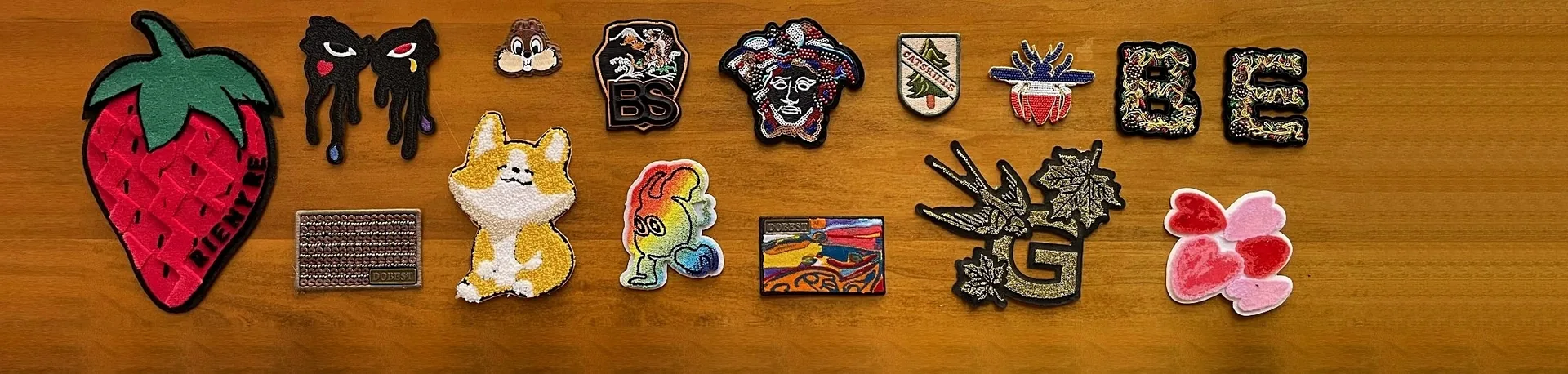
The important distinction is direct embroidery versus patches. Direct embroidery requires the garment to be hooped and handled individually. A patch is produced on a separate backing and then attached — which means a small run of patches can be made efficiently even when a small run of finished garments cannot.
2b. What a 100-piece order actually looks like
A real example makes the trade-off concrete.
A brand wants 100 woven shirts with a 7 cm chest logo, four colours. Run as direct embroidery, the order carries a full digitizing charge, four thread changes per shirt, and individual hooping — the per-piece price lands well above the 300-piece rate, and the factory has to slot 100 single garments into a schedule built around bulk.
Run as patches, the same artwork is digitized once, the patches are produced on a continuous backing, and the attachment happens at the garment maker. The per-piece cost is lower, the schedule is shorter, and if the shirt style changes next season the patches still work.
The difference is not quality. It is which process the quantity can support.
3. Four ways to run a small order
Option 1 — Patch instead of direct. Make 100–300 patches, then heat-press or sew them onto garments as needed. The patch run is efficient; the attachment is flexible. This is the most common solution for small brands and sample ranges.
Option 2 — Combine with an existing run. If the thread colours and backing match something already scheduled, a small order can ride along. This depends on timing, not on goodwill.
Option 3 — Reduce the colour count. Every colour is a thread change. A three-colour design on a small run is significantly cheaper than a nine-colour one.
Option 4 — Simplify the artwork. Fewer stitch transitions and a smaller design reduce machine time per piece — the only variable that scales with quantity.
4. Patches vs direct embroidery for small runs
| Factor | Patch | Direct embroidery |
|---|---|---|
| Minimum efficient quantity | 100–300 | 300+ |
| Garment flexibility | High — attach later | Low — fixed at production |
| Per-piece cost at 100 pcs | Lower | Higher |
| Hand-feel | Slight edge | Seamless |
| Re-work risk | Low — patch can be replaced | High — garment is committed |
If the design may change between styles, patches are the safer base: one patch run can serve several garments.
5. The sampling trap in small orders
The most expensive mistake in a small order is skipping the sample to save time.
On a 5,000-piece order, a 2% reject rate is absorbed. On a 100-piece order, a 2% reject rate is two pieces — and if the design is wrong, it is 100 pieces.
Sample first, then commit. The sample is where you judge pile height, edge quality and colour on the actual fabric. See how pricing is calculated for how sampling costs are treated against bulk.
6. FAQ
Is 300 pieces a hard minimum? It is our standard minimum. Below that we quote case by case — sometimes yes, sometimes the honest answer is that a patch run will serve you better.
Can I order 50 pieces of five different designs? Yes, but treat it as five small runs, not one. Each design carries its own digitizing and set-up.
Do small orders take longer? Usually not longer in production, but they are scheduled around larger runs. Tell us the date you need it and we will say whether it fits.
Can I reorder 100 pieces later without paying digitizing again? Yes — the stitch file is kept. A reorder with the same artwork, size, craft and fabric skips digitizing. Change any of those and it is a new file.
Next step: tell us the quantity, the craft and the date you need it — we will tell you whether a small run or a patch run is the better route. Send your requirement — standard sampling is 24–48 hours.

 2/F, Bldg E, Jinmao Xincheng, No.7 Jiedong South Rd, Xiaojiejiao, Humen, Dongguan, Guangdong, China
 mclau@dobest.hk