

 You are here:
What Is Wool-Thread Embroidery? Process Principles, Yarn Specifications and Selection Guide
 Release time:2026-10-15
 Views:
【Core Definition and Quick Selection】Wool-thread embroidery (Heavy Wool Thread Embroidery / Chunky Yarn Embroidery) is a specialty process that uses thick-count wool blend yarn or bulky acrylic roving on specially modified machines with enlarged needle eyes for wide stitch spacing and long stitch lengths. The stitches are thick and full, with a clear three-dimensional, structured look, bringing the rustic handcrafted feel of natural fiber hairs and a warm, substantial touch. Dobest factory supports an MOQ of 300 pieces, standard sampling in 24–48 hours, complex combined samples in 3–4 working days, free simple samples for 3 styles, and bulk production in 5–10 working days. It is particularly suitable for custom autumn/winter sweatshirts, heavy woolen coats, knit cardigans, vintage workwear jackets, and art tapestries.
I. In One Sentence
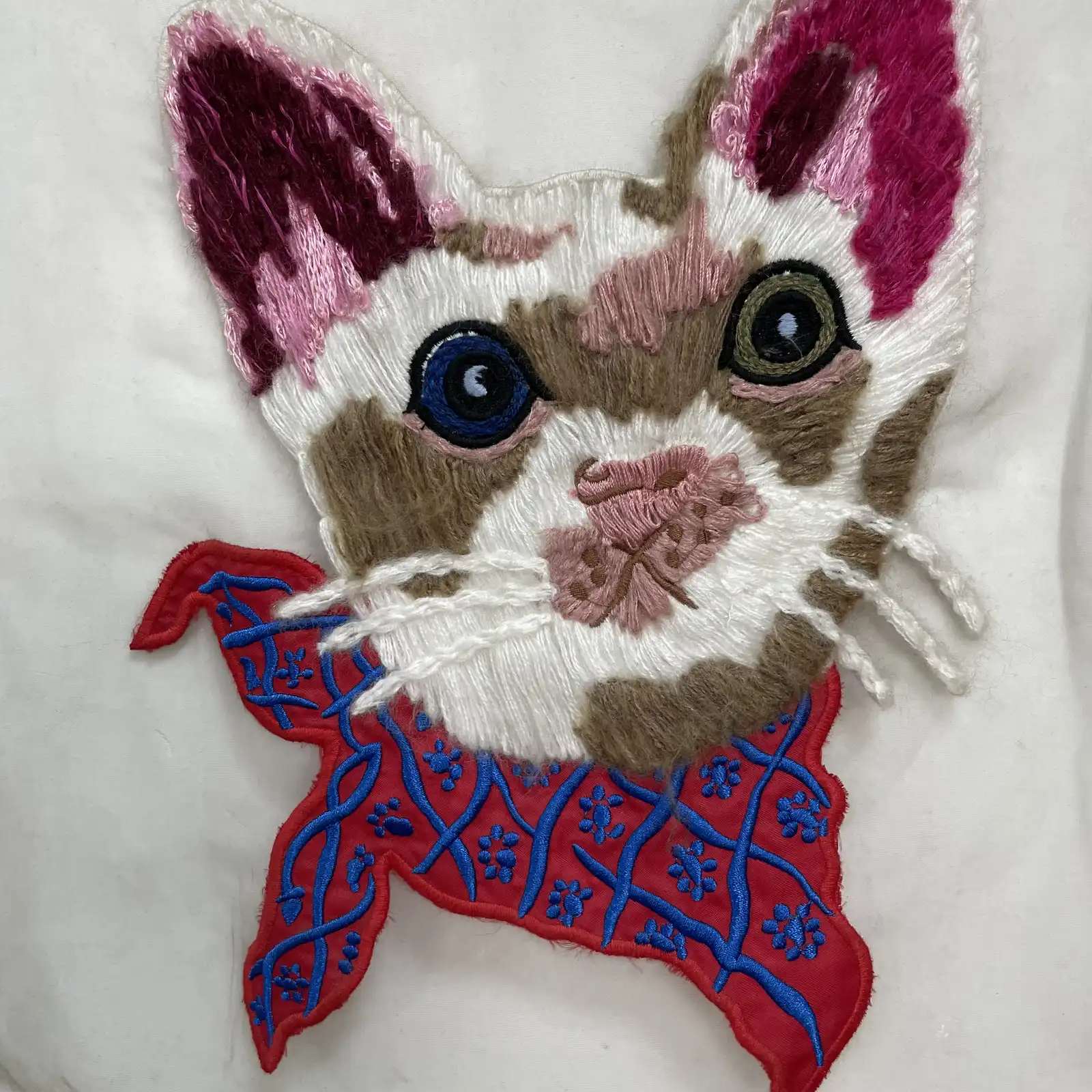
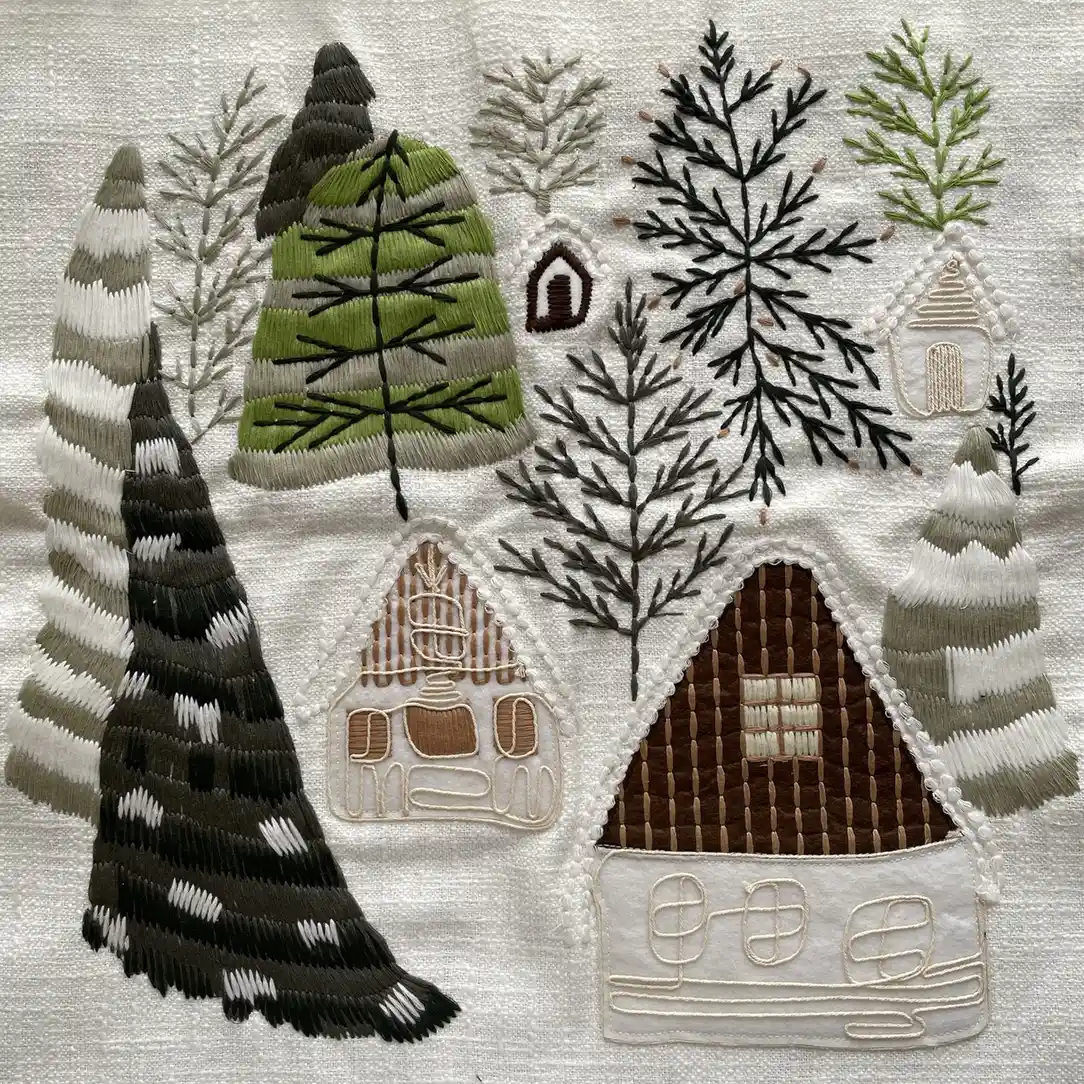
Wool-thread embroidery is a specialty embroidery that uses thick-count wool yarn instead of standard fine filament thread, giving machine embroidery the substantial texture of pure hand knitting: the stitches are full and bold, clearly defined, with a warm, thick fibrous touch you can feel; from a distance it has a relief-like three-dimensional outline, and up close it has the warm texture of hand-knitted wool.
In heavyweight autumn/winter apparel and affordable luxury retro trends, wool-thread embroidery is becoming an effective tool for designers to break away from the flat, thin feel of traditional flat embroidery and create a high-value handcrafted style.
Standard flat embroidery is “fine-line gongbi painting”; wool-thread embroidery is “oil painting with thick strokes.”
II. Common Names and Terminology Clarification (Important—Don’t Get Confused by the Names)
When buyers and designers look for this type of process, the industry commonly uses several different names:
| Industry Term | English Equivalent | Term Origin and Focus |
|---|---|---|
| Wool-thread embroidery | Heavy Wool Thread Embroidery | Formal standard term, emphasizing the use of wool or yarn material and computerized machine embroidery formation. |
| Chunky thread flat embroidery / thick yarn embroidery | Chunky Yarn / Thick Thread Stitch | Common factory digitizing term, emphasizing that the thread diameter is much thicker than standard 120D embroidery thread. |
| Wool embroidery / yarn embroidery | Wool Embroidery / Crewel | A continuation of the traditional handcraft context, focusing on a hand feel similar to hand wool embroidery. |
| Heavy-count acrylic embroidery | Acrylic Heavy Thread Stitch | Distinguished from a material cost perspective; uses bulky acrylic wool-like yarn, which is wear-resistant and washable. |
Process boundaries to clarify:
- Wool-thread embroidery ≠ needle-pile embroidery (brushed pile embroidery): needle-pile embroidery uses standard embroidery thread, then special pile-raising steel needles break the thread on the face to form a fluffy loose pile; wool-thread embroidery uses inherently thick yarn, and the stitches remain intact—not cut or pilled.
- Wool-thread embroidery ≠ chenille embroidery: chenille embroidery uses a bottom curved needle to pull out continuous loop piles; wool-thread embroidery follows a traditional flat-stitch penetrating lockstitch path, presenting bold lines and satin-stitch color blocks.
- Wool-thread embroidery ≠ cord embroidery: cord embroidery places round cord on the fabric surface and tacks it down with fine flat stitches; wool-thread embroidery feeds the wool yarn itself directly through the machine needle, pierces the fabric, and participates in upper and lower thread interlocking and securing.
III. Principles and Forming Technology: How Is It Made?
The core reasons wool-thread embroidery is particularly difficult to machine-embroider are that the yarn is thick, prone to untwisting, and has high friction resistance. Through dedicated modifications to the machine’s electronic controls and core parts, Dobest addresses the challenges of thick thread breakage and fabric damage:
- Dedicated large-eye round-point machine needle: Custom oversized needle eye, highly polished inner eye walls to reduce friction from thick yarn; the round-point design pushes fabric yarns aside during needle penetration rather than cutting fibers.
- Enlarged rotary hook and thread path: Increase the rotary hook clearance and the clearance of the thread path and take-up spring to prevent yarn from untwisting, balling, and clogging during high-speed operation.
- Micro-tension active yarn feed system: In-house modification of the electronically controlled yarn-feed stepper motor enables “near-zero tension” yarn feeding, helping avoid overstretching the thick wool yarn, which can lead to shrinkage and deformation after garment washing.
- Wide-spacing, long-stitch digitizing logic: Digitizing closely follows the physical characteristics of thick yarn: stitch spacing is widened to 1.5–2.5 mm, and long-and-short stitch (thread painting) is used over large areas to lay stitches directionally along the texture.
IV. Effect Specifications (Standard Capability Range)
| Process Control Item | Standard Capability Parameters | Design & Engineering Notes |
|---|---|---|
| Common Thread Specifications | 100D/2 wool-like yarn, 300D–600D coarse-count wool yarn | Genuine wool blend yarn, high-bulk anti-pilling acrylic yarn, bouclé yarn. |
| Minimum Single-Stroke Line Width | ≥ 4.0 mm | Coarse thread has inherent width; below 4 mm, the full, plump texture of coarse thread cannot be expressed. |
| Minimum Letter Height for English Characters | Recommended ≥ 25.0 mm | Small characters tend to blur together; for small letters we strongly recommend pairing with standard flat embroidery. |
| Stitch Density | 1.2 – 2.0 mm | Density should not be too tight; excessive density makes the fabric stiff as a board and may even cut through the base fabric. |
| Maximum Embroidery Field per Design | Approx. 800 mm × 500 mm | Supports large-format back designs and all-over embroidery on large cut panels. |
| Wash Resistance & Care Standard | Recommended: place in a laundry bag, gentle machine wash at ≤ 40℃ or hand wash, dry flat, avoid high-temperature tumble drying. |
V. Hand Feel & Appearance: What Exactly Makes It Stand Out (Weighing Pros & Cons)
Core Advantages (Pros):
- Strong visual weight: thick wool stitches deliver a pronounced relief effect, giving the garment a standout premium and artistic quality.
- Warm, handcrafted touch: retains the rustic hand feel of natural wool fibers, with less of the plastic sheen typical of synthetic embroidery.
- Efficient large-area filling: coarse thread covers more area, requiring fewer stitches for the same area, with a moderate increase in overall garment weight.
Process Boundaries & Physical Limits (Cons):
- Cannot render fine small lettering or macro details: strokes below 3 mm cannot be formed and require pairing with flat embroidery.
- Not suitable for ultra-thin, sheer lightweight fabrics: ultra-light chiffon, silk and similar fabrics cannot withstand the penetration tension of coarse thread and are prone to holes.
VI. Suitable Fabrics & Application Guide (Garment Placement Guide)
Common Embroidery Placements on Garments & Recommended Sizes:
- Hoodie/jacket back main graphic: recommended 25–35 cm, using large color blocks in coarse thread to create a strong visual focal point.
- Autumn/winter outerwear left-chest badge/patch: recommended 8–12 cm, with overlock edging or a woolen base fabric for a 3D fabric patch.
- Terry hoodie front large lettering: recommended letter height 8–15 cm, filled with coarse-thread flat stitches for a vintage collegiate look.
- Wool coat cuffs or hem trim: recommended width 4–8 cm, coarse wool yarn geometric edging and ethnic-style motifs.
Recommended Base Fabrics: heavyweight fleece (400g+), woolen fabric, cashmere coat wool, washed denim, canvas tote fabric, heavyweight rib knit.
VII. Variations & Combined Techniques (One Design Can Use Multiple Techniques at Once)
Coarse wool-thread machine embroidery is often combined with other techniques and used as the main technique in high-end fashion:
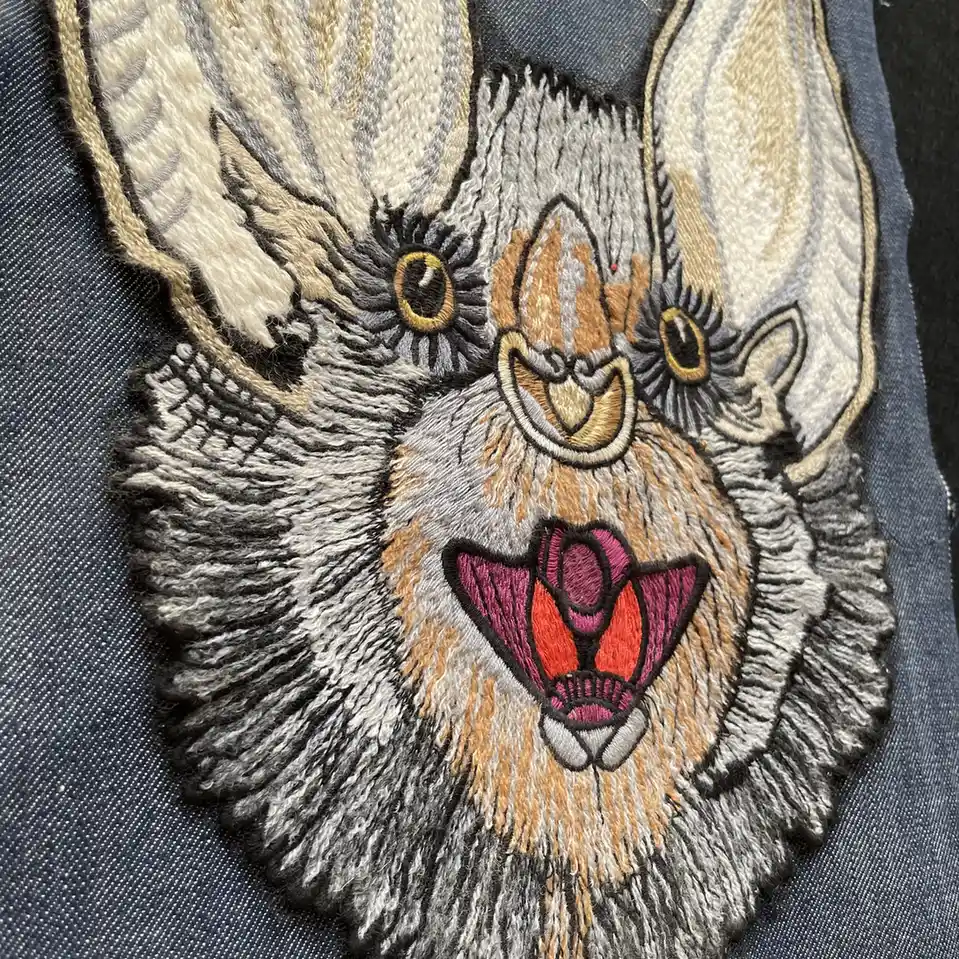
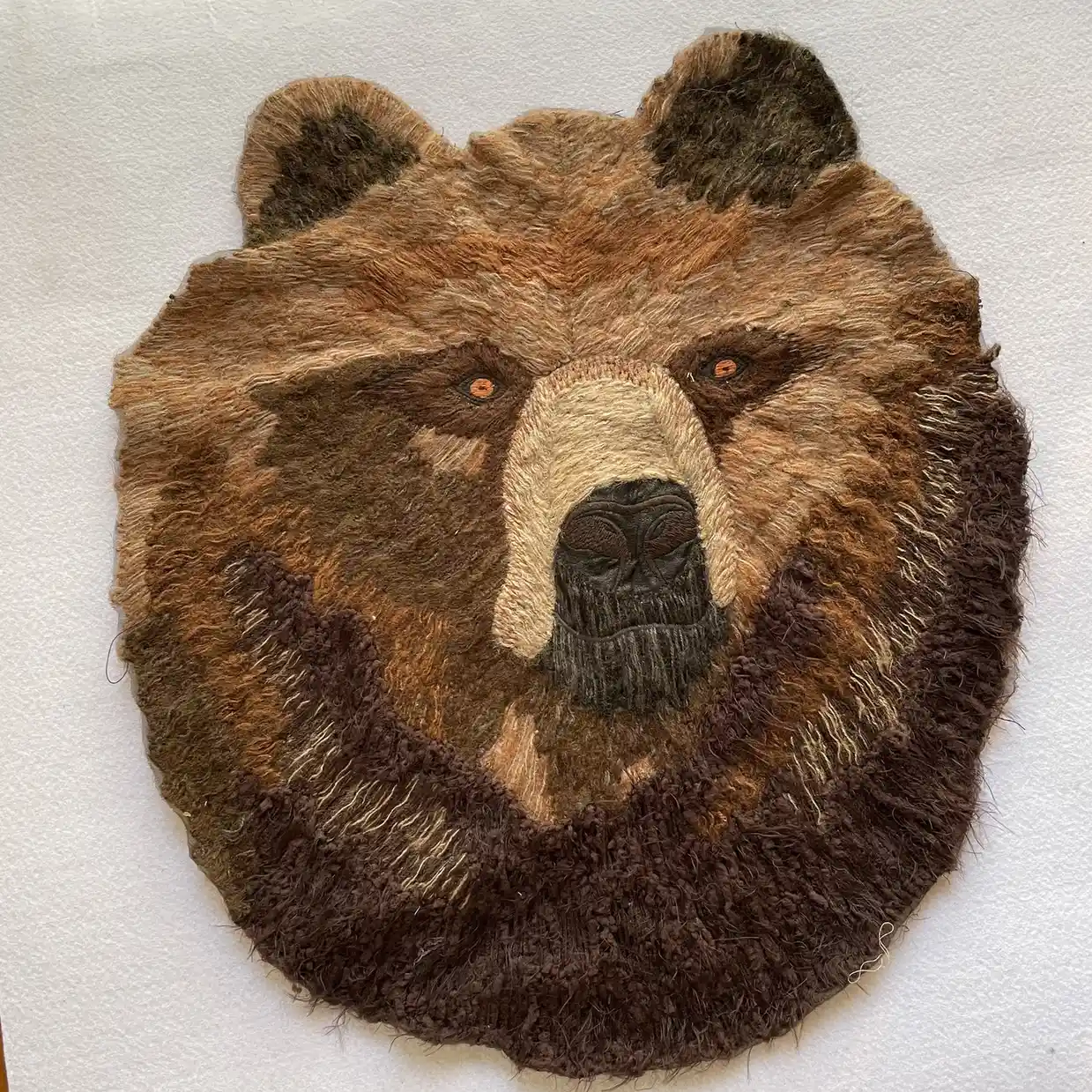
- Coarse wool thread + standard flat embroidery: coarse wool yarn handles large areas of animal fur or petal bodies, while fine flat embroidery (75D/120D) handles eye highlights, whisker outlines and small lettering — bold with fine detail and clear layering.
- Coarse wool thread + sequins/beading: metallic bugle beads or subtle-shine sequins scattered across rustic wool yarn blocks, presenting a couture-like quality.
- Coarse wool thread + appliqué: large woolen fabric cut pieces applied as a base, with the outer edge bordered in coarse wool yarn for a rustic handcrafted look — reducing weight while adding a premium appearance.
VIII. Selection Comparison Chart (Choose at a Glance in One Table)
| Process Category | 3D and Texture Form | Hand Feel | Minimum Line Width | Ideal Style Applications | Relative Cost |
|---|---|---|---|---|---|
| Wool-thread embroidery | Thick-thread 3D flat embroidery with full, raised stitch columns | Substantial and soft, with a handcrafted fuzzy feel | ≥ 4.0 mm | Autumn/winter sweatshirts, coats, vintage workwear | Medium |
| Needle-pile embroidery (brushed pile) | Flat stitches are cut and brushed to form pile | Loose surface fibres, like mink fur | ≥ 3.0 mm | Animal fur details, plush illustrations | Medium-high |
| Chenille embroidery (loop embroidery) | Continuous loop-pile build-up | Soft like terry-loop towelling | ≥ 4.0 mm | American vintage lettering, varsity badges | Medium |
| Standard computerized flat embroidery | Smooth, clean, dense stitching | Tight and even with a noticeable sheen | ≥ 0.8 mm | Fine lettering, workwear logos, versatile | Low |
9. Design and Digitizing Guidelines (6 Pitfall-Avoidance Rules for Designers)
- Keep lettering sizes comfortably large: For all English letters, a height of 25 mm or more and a stroke width of ≥ 4 mm is recommended; below this size, switch to standard flat embroidery.
- Avoid sharp corners and dense back-stitching: Repeated stitching with thick thread can pierce the fabric; use rounded transitions at turns when digitizing, and avoid dense single-point stitching.
- Align stitch direction with the artwork’s perspective: The direction of long and short stitches should follow animal fur flow or muscle dynamics; thick thread can make stitch-path imperfections more visible.
- Allow sufficient fabric shrinkage compensation: Thick-thread embroidery creates slight horizontal pull on the base fabric; digitizers should pre-compensate 3%–5% according to the stretch of the bulk fabric.
- Colour layering should not exceed 2 layers: Two overlapping layers of thick thread can already exceed 3 mm in thickness; more than two layers may prevent the presser foot from passing and can cause needle breakage.
- Balance bobbin thread and tension: Use high-strength fine polyester bobbin thread; bobbin tension may need to be set to approximately 1.5× normal to hold the thick top thread securely.
10. Business Cooperation: MOQ, Sampling and Lead Times
- MOQ: MOQ from 300 pieces (reasonable colour splitting and batch scheduling by style are supported).
- Sampling lead time: After standard vector artwork and fabric are available, first samples in 24–48 hours; complex multi-process combination samples in 3–4 working days.
- Sampling fee policy: 3 simple samples free of charge; a sampling development fee applies to complex samples, fully credited against the order value once the order reaches the MOQ of 300 pieces.
- Bulk production lead time: Standard orders are delivered within 5–10 working days after the approval sample is confirmed; an emergency production scheduling channel is available for urgent fast-turnaround requests.
11. Frequently Asked Questions (FAQ)
Q1 | Will wool-thread embroidery shed or pill? Is it washable?
Dobest uses anti-pilling high-bulk wool yarn and special blended threads, with the embroidery thread passing through the base fabric and fully locked; under normal wear and washing, it is less likely to loosen or come undone. For daily care, turn the garment inside out, place it in a laundry bag, and wash gently at normal temperature; avoid high-temperature tumble drying and high-temperature ironing to prevent wool fibre felting and shrinkage.
Q2 | Can ordinary T-shirts or lightweight sweatshirts be used for wool-thread embroidery?
Fabrics under 300 gsm are not recommended for direct large-area embroidery, as this can cause fabric pulling and wrinkling. For lightweight garments, we recommend a 3D embroidered patch on a wool-fabric base (patch), attached to the garment by sewing or with a heat-activated adhesive backing.
Q3 | Can small letters designed by our designers be done in thick wool-thread embroidery?
Small letters below 20 mm high are difficult to render with a clean outline using thick thread. We offer a proven same-machine combination embroidery solution: “large thick-wool motif + fine flat-embroidered small lettering,” preserving the rugged texture of the main motif while keeping small letters clear and sharp.
Q4 | Will wool-thread embroidery feel scratchy on skin? Can it be worn next to skin?
The bobbin thread uses ultra-fine soft polyester thread, and the back is flat and smooth; for next-to-skin unlined sweatshirts, a soft-handling process can be used, or an ultra-soft anti-scratch interlining can be added for greater comfort even for babies and sensitive skin.
12. Contact Us
Dongguan Dobest Industrial Co., Ltd. (Dobest) was founded in 2013 and has focused on the R&D and manufacturing of specialty computerized embroidery for 13 years. It has a 3,000 m² modern production workshop and more than 30 specialty computerized embroidery machines. The company has passed Disney ILS and adidas SEA international brand factory audits and has been rated Class A Taxpayer for four consecutive years. Custom R&D from drawings and samples and fast-response sampling are supported.
Service hotline / WeChat: 13712297700 | Official website: dobest.hk | Submit a sampling request online
Service Areas (On-site Visits in the Pearl River Delta)
We can meet customers on-site in Dongguan, Shenzhen, Foshan (including Shunde), Zhongshan, Guangzhou, Zhuhai, Huizhou, Jiangmen and other Pearl River Delta cities; for central Guangzhou and surrounding areas (Haizhu, Liwan, Tianhe, Baiyun, Huangpu, Panyu, Huadu, Nansha, Conghua, Zengcheng) and Dongguan localities (Humen, Houjie, Chang’an, Dalang, Changping, Dalingshan, Shipai, Chashan, Tangxia, Liaobu, Dongcheng, Nancheng, Wanjiang and other towns/subdistricts), we can usually visit within half a day to discuss and review samples. Clients outside the region and overseas can send samples by courier and get them returned.

 2/F, Bldg E, Jinmao Xincheng, No.7 Jiedong South Rd, Xiaojiejiao, Humen, Dongguan, Guangdong, China
 mclau@dobest.hk