

 You are here:
Tuft Stitch Embroidery: What It Is and What to Call It
 Release time:2026-11-07
 Views:
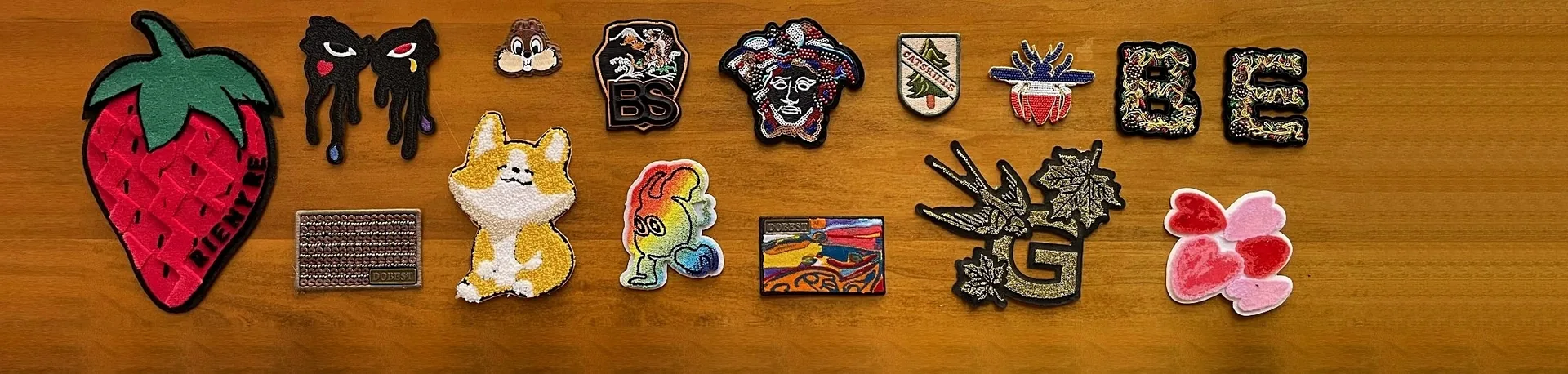
Tuft Stitch Embroidery is a computerized embroidery technique in which the thread is stitched so densely, and cut so short, that the pile stands upright instead of lying flat — the same family of work most apparel buyers know as toothbrush embroidery. If you are comparing names, specifications or suppliers for this raised pile effect, this page covers the tuft side of the picture and points you to the full terminology breakdown.
1. In one sentence
Tuft stitch embroidery is machine embroidery that builds a dense, cut, upright pile on the surface of the base fabric, so the motif reads as a soft raised patch rather than flat stitching.
The definition matters commercially: the pile is produced by stitch geometry, not by printing, coating or adhesive. Everything else on this page follows from that single fact.
2. Why so many names
This technique is sold under several names. For the full name-by-name comparison, see section 2 of our Toothbrush Embroidery Guide.
The duplication is historical rather than technical. Buyers arriving from home textiles and carpet sourcing reach for tufting embroidery or tuft stitch, because the vocabulary of cut-pile carpet is already familiar to them. Buyers arriving from apparel, patches and teamwear reach for toothbrush embroidery, because the bristle analogy describes the hand-feel faster. Both camps are describing the same construction.
Some suppliers also list this work as flocking embroidery. That term is used loosely in the trade, and it is worth separating carefully from the printing process that shares similar wording — see the note in section 3.
3. The structure: why the pile stands up
The pile does not stand up because of glue, foam or a raised substrate. It stands up because of how the stitches are built and finished.
A dense satin or fill block is laid down first, so that the surface is fully covered before the pile is formed. The pile is then cut to a controlled height rather than left as a loop. Finally the thread ends are locked at the back of the base fabric, which is what keeps each column of thread anchored under handling, folding and washing.
That is why the surface is properly called cut pile: the loops are cut open and left standing vertically. A correctly built tufted surface keeps its shape because every column is rooted in the base fabric. A surface that only looks similar is usually either a loop pile, which lies flat, or a printed effect, which has no thread standing at all.
Flocking embroidery here means the embroidered upright-pile technique; it is not electrostatic flocking (flock printing), which is a glue-and-static printing process, not embroidery. The two can look alike at arm's length, because both leave short fibres standing on the surface, but the fibre in one case is fired into an adhesive layer by static charge, and in the other it is thread that passes through the fabric and is locked at the back. This distinction is set out in full — alongside the other confusions worth clearing up — in the subsection "Toothbrush embroidery is not electrostatic flocking" in section 2 of our Toothbrush Embroidery Guide.
4. Tuft stitch, toothbrush and chenille: how tufting fits in
These three words get used interchangeably in quotation requests, and they should not be.
Tufting embroidery and toothbrush embroidery describe the same cut-pile construction. There is no structural difference between them; the choice of word usually reflects the buyer's industry rather than the product.
Chenille embroidery is a different construction. It uses a chenille head to form loops of thread, in the way terry towelling forms loops, and those loops are ring-shaped and lie flat against the fabric. The relief is soft but low, and the surface has a looped texture rather than a cut one.
The practical consequence is that a brief asking for "tufting embroidery" and a brief asking for "chenille embroidery" are not the same brief, even though both sound like "raised soft embroidery" to a non-specialist. A cut pile stands up and can be brushed in one direction; a chenille loop stays looped. If the design depends on the pile catching light or standing proud of the fabric, cut pile is the right construction. If it depends on a continuous looped texture, chenille is.
For the full comparison of construction routes, including the three ways of setting the pile root, see sections 3 and 5 of the Toothbrush Embroidery Guide. For the loop-based alternative in detail, see Chenille Embroidery.
5. Specifications
The figures below are standard capability ranges for production runs, not laboratory limits. Actual results depend on artwork, base fabric and finishing route.
| Parameter | Standard range | Notes |
|---|---|---|
| Pile height | 1.0–10.0 mm | 2.0–3.5 mm is the common working range for apparel and patches |
| Pile type | Cut pile, upright | Loops are cut open; the surface is brushed or left natural |
| Minimum detail | Around 1.5× the pile height | Below this the columns merge and the edge stops reading cleanly |
| Base fabrics | Cotton, poly-cotton, fleece, twill, felt, knit | Stable, tightly woven or knitted surfaces hold the root best |
| Fabrics needing review | Thin knits, high-stretch, loose weave, coated shells | Usually need a stabiliser or a backing decision before sampling |
| Backing | Fusible or sew-on, on request | Backing choice is a wear and wash question, not only a cost question |
| Colour | Any thread colour available from stock or matched to Pantone | Gradients and space-dyed effects are possible in one pass |
Two specification points cause most of the sampling rework. The first is minimum detail: designers frequently specify lettering or fine outlines that are narrower than the pile can physically hold, and the fix has to happen at artwork stage, not at the machine. The second is base fabric: a stretch knit that is not stabilised will distort the pile height across the motif even when the stitch file is correct.
6. Sourcing notes
If you are sourcing 3D tuft stitch embroidery patches from a supplier, the questions that separate a capable factory from a broker are predictable: how the pile root is locked at the back, what the minimum detail is at the pile height you want, and what the factory does when a base fabric behaves badly.
Typical commercial terms for this work:
- Minimum order quantity: 300 pieces. Smaller runs can be evaluated case by case, depending on artwork and thread colours.
- Simple samples: three designs free of charge. Complex or multi-technique samples carry a sampling fee, which is credited against the order once it reaches the MOQ.
- Sampling lead time: 24–48 hours for straightforward designs; three to four working days for complex or combined techniques.
- Bulk lead time: 5–10 working days, confirmed against the production schedule. Urgent programmes can be prioritised where capacity allows.
Because the pile is a physical structure rather than a print, the sample is the real specification. Thread colour, pile height and base fabric interact, and a sample made on your actual fabric is the only reliable way to confirm hand-feel before bulk.
To discuss a programme, see toothbrush embroidery for the cut-pile product range, or read about our embroidery manufacturing capability. You can also contact us with artwork or a physical sample.

 2/F, Bldg E, Jinmao Xincheng, No.7 Jiedong South Rd, Xiaojiejiao, Humen, Dongguan, Guangdong, China
 mclau@dobest.hk