

 You are here:
What Is Toothbrush Embroidery? Principles, Pile Heights and a Selection Guide
 Release time:2026-10-05
 Views:
Toothbrush embroidery is a 3D embroidery in which the thread stands up into columns; it is also called vertical pile embroidery, bristle embroidery, turf embroidery, tufting embroidery or flocking embroidery. Standard pile height 1.0–10.0 mm, commonly 2.0–3.5 mm; the thread passes through the fabric on a single side and is heat-locked with TPU, so it resists shedding after washing. MOQ 300 pieces, sampling in 24–48 hours; suited to hoodies, caps, bags, woven labels and kidswear.
1. In one sentence
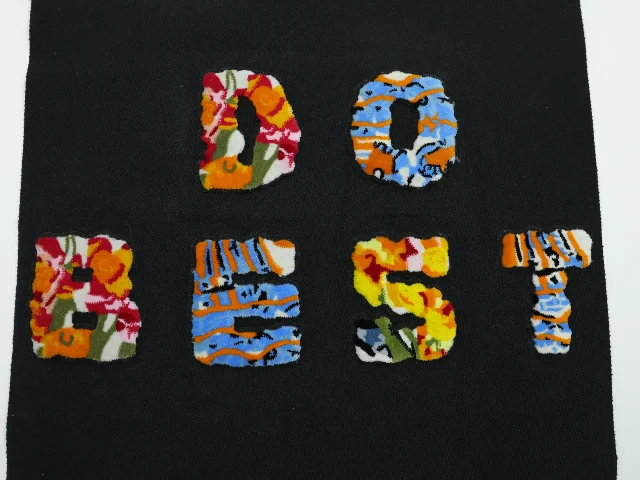
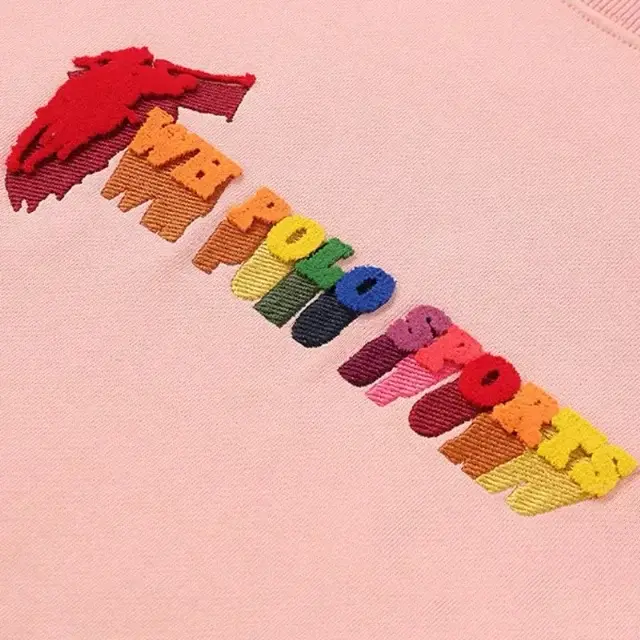
Colourful letters at 3.0 mm pile, hoodie chest
Toothbrush embroidery is a 3D embroidery that makes the thread stand up: the yarn rises vertically from the fabric like toothbrush bristles, it can be felt and springs back, and it gives a clear outline from a distance and a pile surface up close — hence it is also called vertical pile embroidery.
Now widely adopted by high-end fashion and sports and streetwear brands, it is a prominent embroidery technique on hoodies, baseball caps, jackets, bags, woven labels and badges.
The difference from ordinary embroidery can be explained to a customer in one line:
Ordinary embroidery lies flat on the fabric; toothbrush embroidery stands on it.
2. Names and terminology (important — don't be confused by the labels)
On the market this technique goes by several names, and customers search using different words:
| Name | Explanation |
|---|---|
| Toothbrush embroidery | A common name, from the toothbrush-bristle effect |
| Vertical Pile embroidery | A more technical name, emphasising that the thread stands upright |
| Flocking embroidery | Used loosely in the trade; many customers search this term directly |
| Turf embroidery | From the turf-like surface; common in streetwear circles |
| Tufting embroidery | More common in English usage and in home textiles and carpets |
Three easy confusions to clear up:
Toothbrush embroidery is not electrostatic flocking
Electrostatic flocking (flock printing) is a printing and surface-treatment process — glue is screen-printed onto the fabric and then hundreds of thousands of volts of static electricity fire short fibres vertically into the adhesive layer. It belongs to flock printing, not embroidery. Both leave an upright pile on the surface, which is why non-specialists confuse them, but the methods, equipment, costs and durability logic are completely different: flocking relies on glue, while we rely on the thread passing through the fabric with heat-locked roots at the back.
Toothbrush embroidery is not chenille embroidery
Chenille embroidery uses a chenille head to form loops of thread, like the little loops in towelling; those loops are ring-shaped and lie flat. Toothbrush embroidery cuts the pile columns and leaves them standing. The two are often combined (see section 7).
Toothbrush embroidery is not 3D puff embroidery
3D puff embroidery places EVA foam underneath and covers it with dense satin stitching, so the relief is solid and firm; the relief of toothbrush embroidery is soft and furry.
What a customer usually wants is “a dimensional, furry, touchable embroidered effect”. So we ask about the application and the hand-feel preference first, then help you decide: soft pile → toothbrush embroidery; loops → chenille embroidery; crisp hard edges → 3D puff embroidery; a flat flocking graphic in volume at low cost → that is where electrostatic flock printing comes in.
3. The principle: why can the thread stand up?
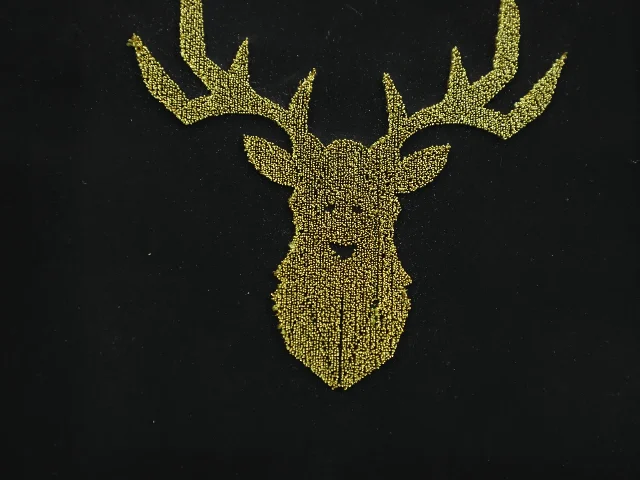
Gold-thread toothbrush embroidery: upright pile under raking light
Embroidery thread is soft by nature, and there are three common technical routes to make it stand up:
Three routes: heat-sealed roots, face clamping, appliqué pile
- Route 1 | Support material left in place (mainstream): a layer of supporting material of a set height (such as EVA) is placed before stitching, the thread is stitched densely over it, and after stitching the top is sheared flat and the support removed, leaving the pile columns standing.
- Route 2 | Loops formed and cut on a chenille head: a chenille embroidery head first forms loops and then cuts or breaks them into pile. Good for large areas, but weaker on small letters and fine lines.
- Route 3 | Single-sided upright thread (our main route): through in-house modification of machine parts and electronic controls, thread is passed through the fabric as a single-sided line to form columns. The roots are not held by glue but are heat-locked at the back, welding the lower end of every thread firmly to the reverse of the base fabric, followed by CNC pile shearing, dust removal and setting.
Our production flow, step by step
- Density-compensated punching — stitch density is pre-compensated according to the height of the artwork so heights are uniform after shearing;
- Single-sided upright machine embroidery — thread is passed through the fabric to form columns;
- Heat-locking at the back — a heat-melt material is laminated and pressed across the reverse to fix the thread roots to the back of the fabric (the key to a stable pile that resists shedding);
- CNC pile shearing — the tops of the columns are sheared to the specified height;
- Dust removal, setting and full inspection — negative-pressure dust removal, hot-air setting and piece-by-piece re-inspection of pile surface and height consistency.
Root locking is what decides wash durability
Why does “root locking” deserve this much attention? Because the quality difference in toothbrush embroidery — whether it sheds — comes almost entirely down to how well the roots are locked. Another common approach clamps the thread roots with face stitching alone. The two structures behave differently under repeated washing and abrasion, and the actual result should be confirmed by wash testing. Our method welds the whole set of thread roots from the reverse, which is where our confidence in keeping the pile stable comes from.
Need pile height and pricing assessed from your artwork? Contact us
4. Specifications (standard capability ranges)
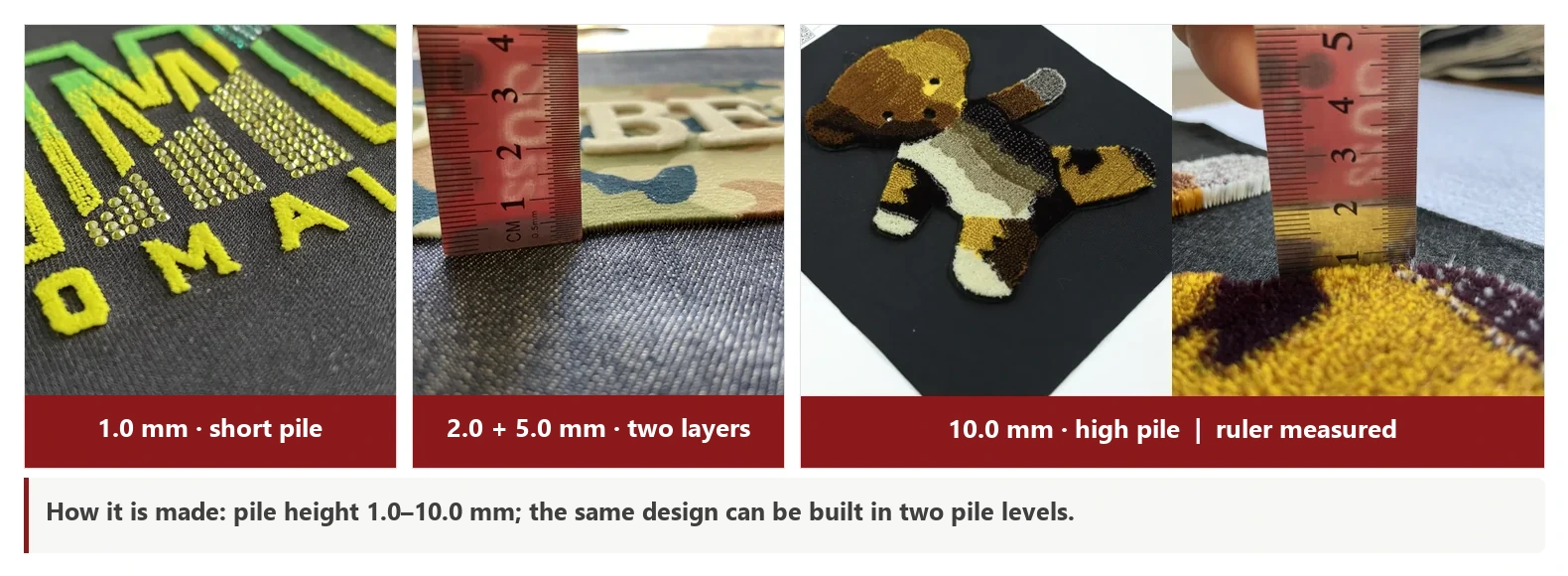
Pile height comparison: 1.0 mm short pile | 2.0+5.0 mm two-tier | 10.0 mm high pile (finished piece on the left, ruler measurement on the right)
| Item | Specification |
|---|---|
| Pile height (column height) | 1.0–10.0 mm, commonly 2.0–3.5 mm |
| Height variation | Different heights can be set within one design, roughly 1.0–1.5 mm of variation (a sculpted layering) |
| Common yarns | 120D/2 and 150D/2 polyester; rayon for high-gloss effects |
| Minimum line width | Suggested ≥ 2.5–3.0 mm (a single line below about 1.5 mm will scatter and blur after shearing) |
| Minimum spacing between letters | ≥ 2.0 mm |
| Minimum letter height | about ≥ 10 mm |
| Single embroidery field | about 1200 × 800 mm (larger by joining fields) |
| Stitch density | adjustable at the 0.08 mm level for fine expression of artwork |
| Washing and durability | day to day we recommend washing inside out below 40℃ in a laundry bag, and avoiding high-temperature drying and ironing |
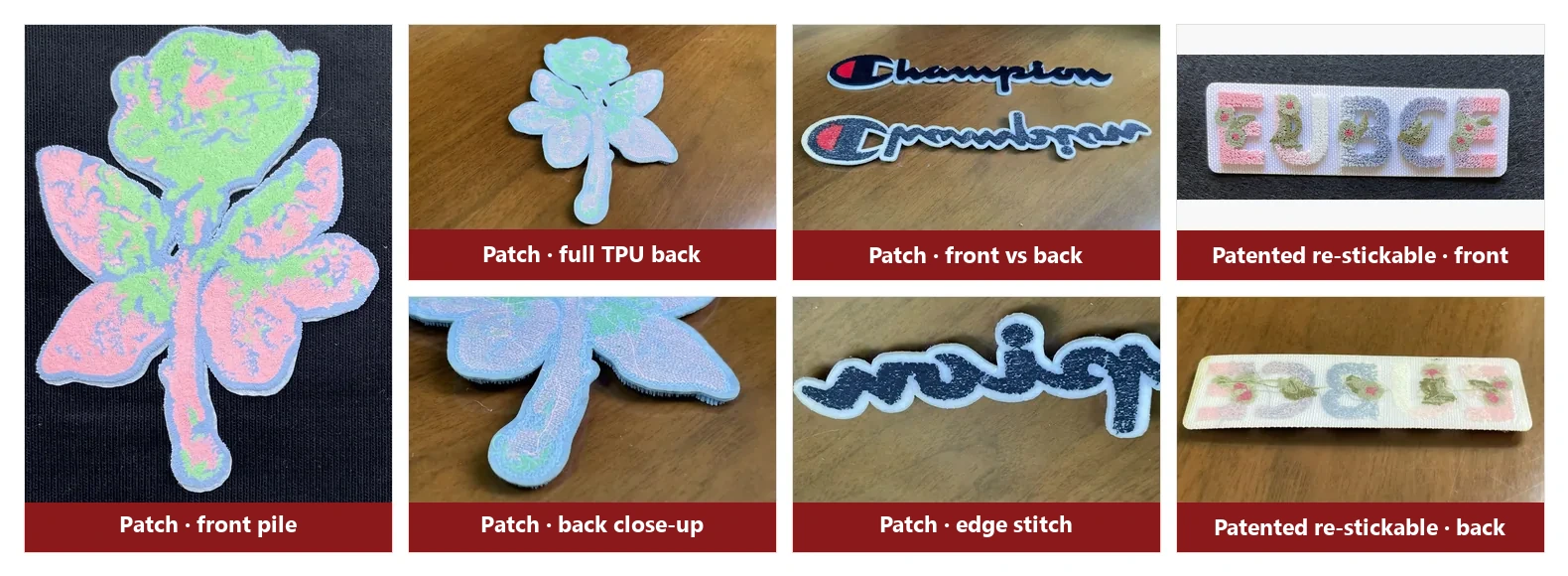
Patch: full-surface TPU film (for heat application). Direct-on-garment embroidery applies TPU only at the embroidery area plus a backing cloth for skin comfort and moisture absorption. Bottom right: re-positionable patented embroidered patch (CN222896500U).
Note: the above are standard capability ranges; the actual result is confirmed by sampling — the feasible range varies with fabric, artwork and washing requirements, so we sample first and only then discuss production.
5. Hand feel and appearance: what exactly is good about it
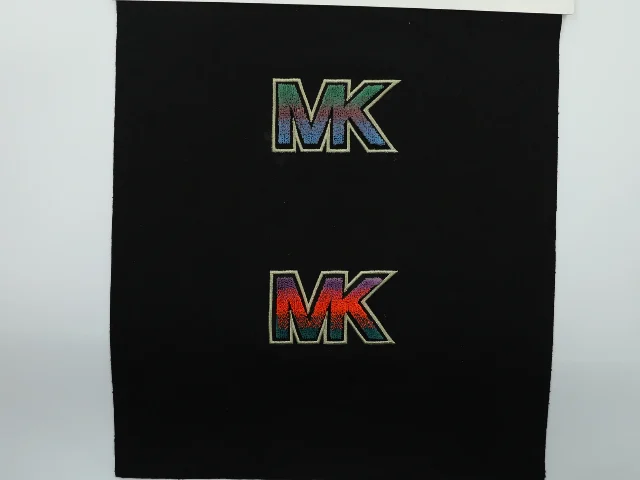
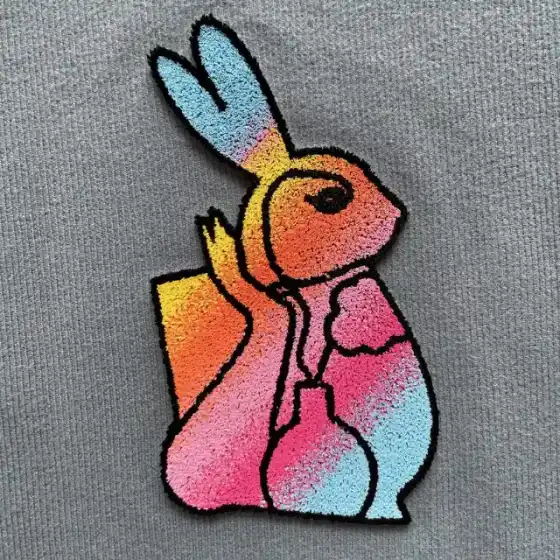
Two gradient toothbrush-embroidery effects on one motif
- A real sense of presence: a clear 3D outline from a distance, individual pile up close — it photographs and films well;
- Touchable and memorable: a logo or lettering can be touched and remembered, which is its value as a brand-identification device rather than mere decoration;
- Soft and skin-friendly: not a hard bump but a soft pile, so it works for kidswear and home textiles too;
- Bright, direct colour: the pile absorbs light for a matt look, and colours come through directly and fully;
- Durable: the structure is firm and resists washing and crushing — a light pat or a low-temperature hot-air pass restores the loft after compression.
Positioning: youthful, sporty and casual, and also warm and skin-friendly because the pile is soft — well suited to streetwear, sportswear, kidswear, home textiles and brand badges.
6. Fabrics and applications
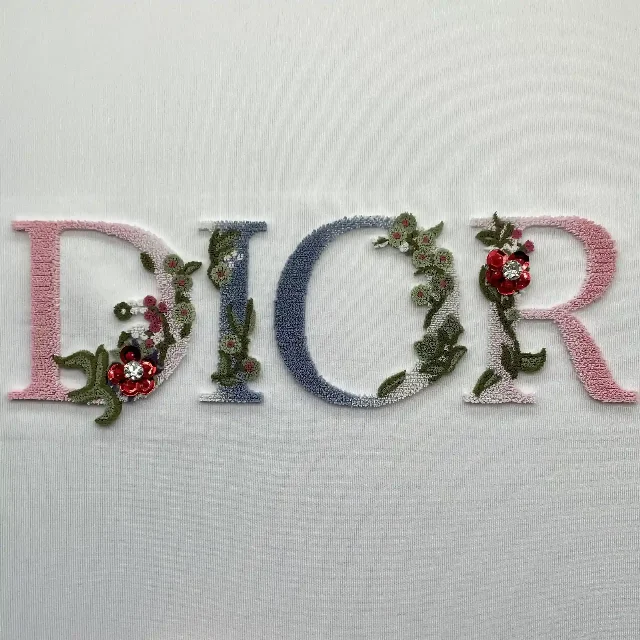
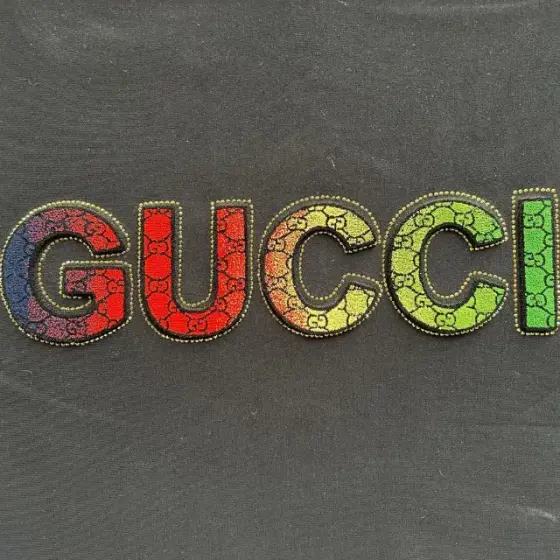
Gradient toothbrush embroidery with hand beading
Fabrics and placements that work
Good performance: hoodie fleece, loop-back fleece, brushed and polar fleece, canvas, denim and cotton — woven and knitted fabrics of moderate weight; the stiffened front panel of a baseball cap is a typical substrate.
Possible with care: ordinary knit and thin cotton. On thin materials we recommend hook-and-loop fabric labels or heat-transfer embroidered patches — make the embroidered piece first, then apply heat transfer or hook-and-loop, avoiding large areas of pile formed directly on thin fabric, which distorts.
Cases we advise against or need reinforcement
Handle with caution (must be discussed before ordering): highly elastic knits (require greater bobbin pre-tension, a slightly adjusted presser-foot height, or our backing-free route instead), silk-like thin materials, and fabrics with a waterproof coating or silicone finish (these affect lamination adhesion and must be adhesion-tested first).
Good product fits: hoodies, jackets, baseball uniforms, hats, bags, woven labels, brand badges, kidswear, sports and casual ranges and home textiles. See the toothbrush embroidery section for styles and case studies.
Not suitable — and we will say so up front: lettering with extremely fine strokes; large areas on ultra-thin fabric; areas of long-term, high-frequency friction (inside cuffs, crotch, pocket edges); and applications that must be completely flat and thin.
Not sure which route suits your fabric? Send us the fabric and artwork
7. Variants and combined techniques (one design can use several)
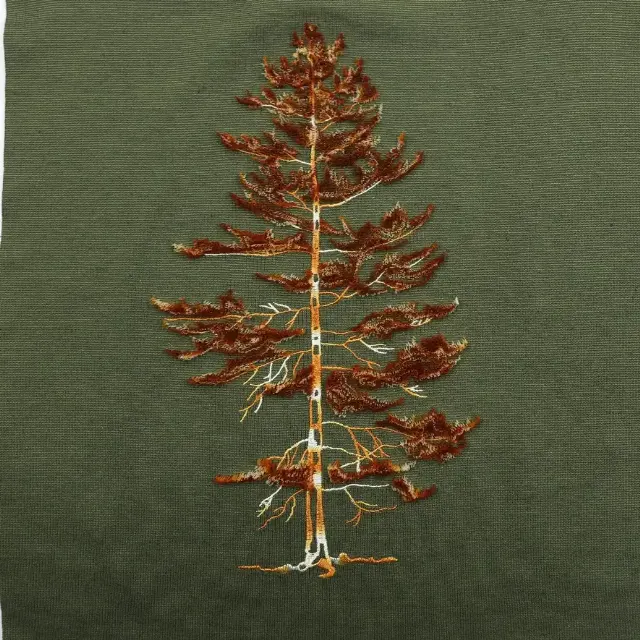
Toothbrush pile tree crown with flat-stitch trunk, two textures
One of toothbrush embroidery's key strengths is that it can sit in the same artwork as other techniques to create layering and texture:
- Toothbrush + chenille embroidery: toothbrush for the main letters or graphics, chenille for ground patterns or borders — one soft pile, one loop, clearly layered;
- Toothbrush + 3D puff embroidery: hard 3D for the core element, soft toothbrush pile at the edges — solid from a distance, furry up close;
- Toothbrush + laser cut-out: cut-outs inside the motif for lightness and a see-through effect;
- Toothbrush + appliqué: appliqué for large colour blocks, toothbrush pile as accents;
- Toothbrush + flat or sequin embroidery: flat embroidery for outlining and grounds, toothbrush for the body, sequins for highlights;
- Multi-level heights: combine 2.0 mm, 3.5 mm and other pile heights within one design for stepped layering and a more refined look.
8. Selection comparison (how to choose)
| Technique | Form | Pile height / height | Hand feel | Minimum stroke | Typical applications | Cost |
|---|---|---|---|---|---|---|
| Toothbrush | upright columns, dimensional pile | 1.0–10.0 mm (typically 2.0–3.5) | soft, furry, resilient | about ≥ 2.5–3.0 mm | hoodies / caps / bags / labels / kidswear | medium-high |
| Chenille | loops (ring-shaped) | 2–6 mm (typically 2–4) | soft, with a loop feel | about ≥ 4.0 mm | lettering, kidswear, home textiles | medium |
| 3D puff | firm raised relief, crisp outline | Foam 2.0 / 2.5 / 3.0 / 4.0 mm | solid, stiff, powerful | about ≥ 4.0–6.0 mm | cap badges, sportswear, firm logos | high |
| Electrostatic flocking (printing) | a layer of upright flock on the surface | Not applicable (surface flock, no upright pile) | furry, matt, but glue-based | thick lines only | large flat graphics, packaging, interiors | low |
| Ordinary flat | flat | None | smooth, thin | fine letters possible | fine letters, small graphics, large areas | low |
In one line: soft and dimensional → toothbrush; loops → chenille; crisp and hard → 3D puff; flat, large area, low cost → flock printing or flat embroidery.
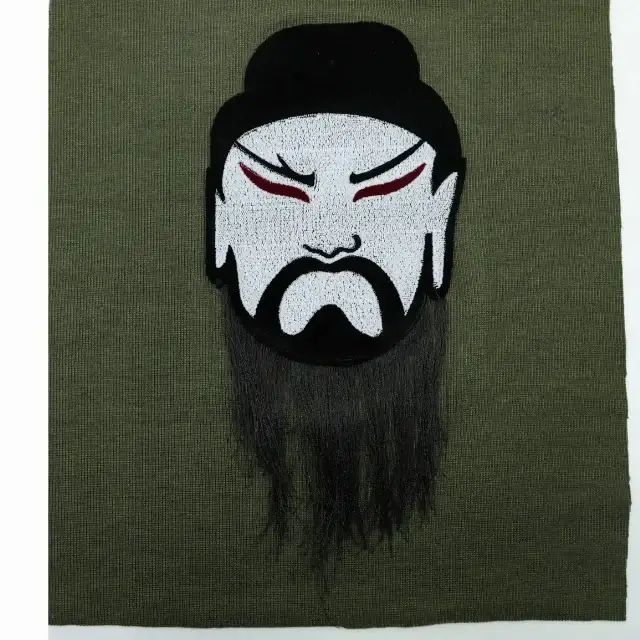
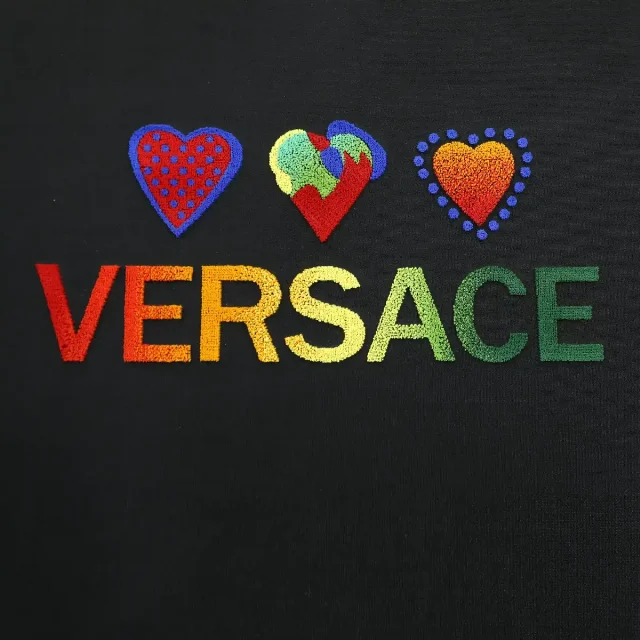
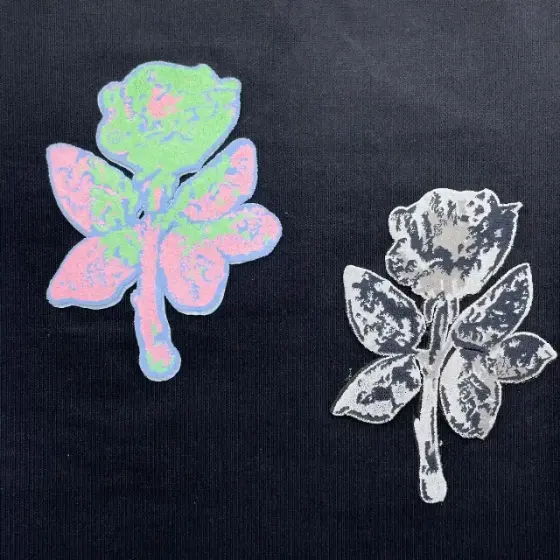
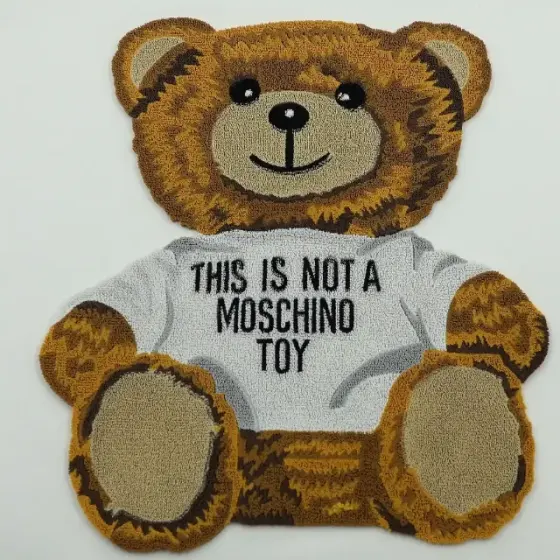
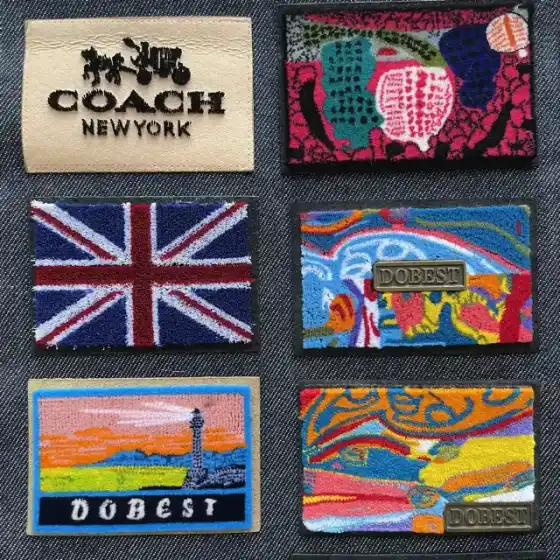
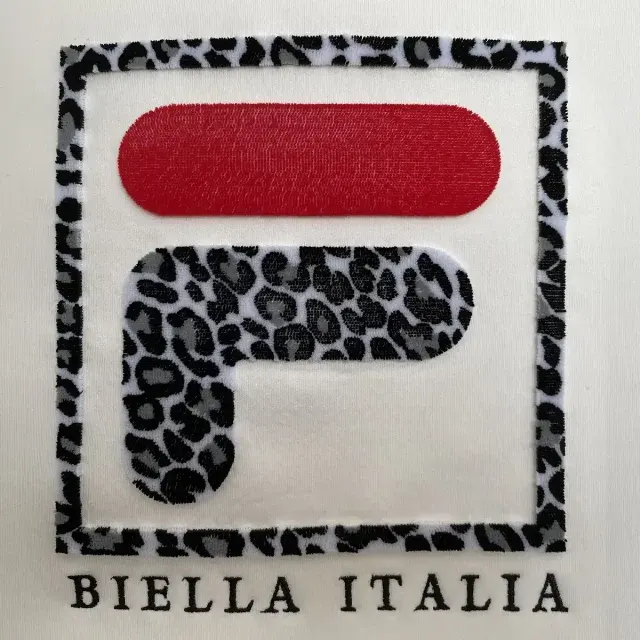
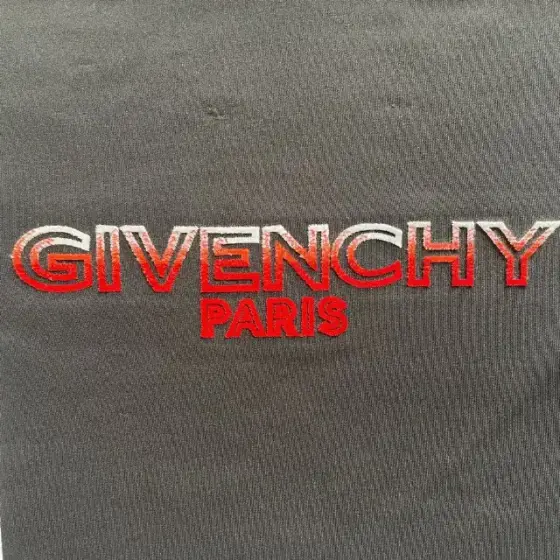
Same technique, different results (8 examples)

9. Design and punching notes (six points for your designer)
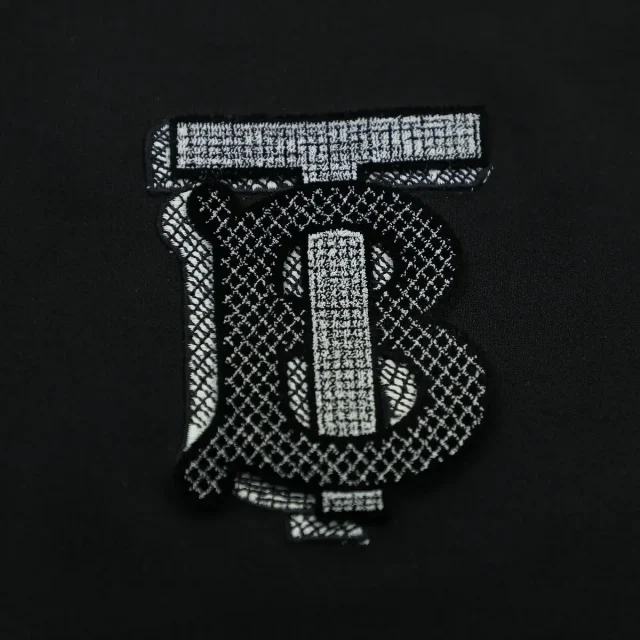
Thick patch test piece: toothbrush embroidery plus tatami flat fill
- Line width: a single stroke should be ≥ 2.5–3.0 mm, and 4–6 mm is safer; strokes that are too fine are “eaten” by the column structure and the result blurs.
- Sharp angles: avoid angles below 45° and extremely fine points — these are where the pile collapses first, is harder to shear flat and more likely to expose the backing.
- Height variation: set different pile heights by zone within one design (for example 2.0 mm at the front, 4.0 mm for the main body) to create layering.
- Spacing: leave ≥ 2.0 mm between cut-out areas and adjacent pile columns to avoid bridging and unclear boundaries.
- Colour: keep colours few and solid; dense, fine designs are not economical in toothbrush embroidery and the effect suffers too.
- Version management: different batches of the same fabric and different sizes of the same artwork must all be re-sampled and confirmed — do not simply scale artwork up or down; keep punching files under version control, never overwriting or mixing them.
Have artwork and want a feasibility check first? Send it for a process review
From artwork to shipment: five stages
- Artwork review — quoted on five factors: artwork complexity, pile height, fabric, quantity and finishing
- Punching — stitch path and root-locking plan produced from the artwork
- Sampling — samples in 24–48 hours (3–4 working days for complex multi-technique work)
- Approval — you confirm pile height, hand feel and colour
- Bulk production — 5–10 working days, MOQ 300 pcs
10. Sampling, lead times and MOQ
- Sampling: with artwork complete, a physical sample in 24–48 hours; about 3–4 working days for complex multi-layer or combined techniques.
- MOQ: 300 pieces.
- Sampling fee policy: up to 3 simple samples free; complex samples are charged, and the fee is deductible against the order once the 300-piece MOQ is reached.
- Bulk lead time: normally 5–10 working days, subject to production scheduling; rush orders can be scheduled first.
- Why sampling is essential: the final result of toothbrush embroidery is shaped by fabric, yarn, pile height, shearing and lamination together, and a computer rendering cannot replace a physical sample. Insisting on “sample first, then talk about volume” also protects the delivery expectations on both sides.
11. Frequently asked questions (FAQ)
Q1 | Are toothbrush, flocking and electrostatic flocking the same thing?
No. Toothbrush embroidery (also called vertical pile embroidery) makes the embroidery thread stand up into columns; electrostatic flocking is a printing and surface-treatment process that glues short fibres onto adhesive with static electricity, and belongs to flock printing, not embroidery; flocking embroidery is a loose trade term for “embroidery with a pile surface”, and many customers searching that word actually want a dimensional pile embroidery effect — we judge by your real requirement which method to use.
Q2 | Will it shed? Can it be washed?
Our method heat-locks the root of every thread from the back, so it resists coming loose in normal wear and washing. day to day we recommend washing inside out below 40℃ in a laundry bag and avoiding high-temperature drying and ironing.
Q3 | How fine can it go? Can it do small letters?
A single stroke should be ≥ 2.5–3.0 mm, spacing between letters ≥ 2.0 mm, and letter height about ≥ 10 mm. Below that it blurs and scatters and we do not recommend forcing it — such fine-line requirements are better served by flat embroidery.
Q4 | How high can the pile go?
Normally 1.0–10.0 mm, and commonly 2.0–3.5 mm. The higher the pile, the harder the trimming and the greater the washing risk, so we advise by product use (for caps, for example, around 3 mm usually sits well).
Q5 | How are MOQ and sampling arranged?
MOQ 300 pieces; up to 3 simple samples free, complex samples charged and deductible against the order once the MOQ is reached; sampling normally 24–48 hours, and 3–4 working days for complex combined techniques. The more complete your materials (vector file, AI, PDF or high-resolution image), the faster the sample.
Q6 | How is the price calculated?
Five things drive the quotation: finished size, pile height, number of colours, backing and backing-adhesive type, and quantity. The same artwork at a different pile height uses a different amount of thread and shearing time, so the price moves noticeably. Send us the artwork file, the product and fabric it is for, the pile height and hand feel you want, and the quantity and lead time — we can quote and advise on sampling within 24 hours.
Q7 | Can we visit the factory and see the machines running?
Yes. We are at Floor 2, Building E, Jinmao New Town, Jiedong South Road 7, Xiaojiejiao, Humen, Dongguan, Guangdong. Visits to watch the machines run and see live orders can be booked in advance. For customers across the Pearl River Delta — Dongguan, Shenzhen, Foshan (including Shunde), Zhongshan, Guangzhou, Zhuhai, Huizhou and Jiangmen — we can also come to you.
Q8 | Do you have export experience and factory-audit credentials?
Yes. We hold licences for goods and technology import and export, and have passed Disney ILS and adidas SEA factory audits; we have been an A-grade taxpayer for four consecutive years (2021–2024), are a general VAT taxpayer, and can issue 13% VAT special invoices.
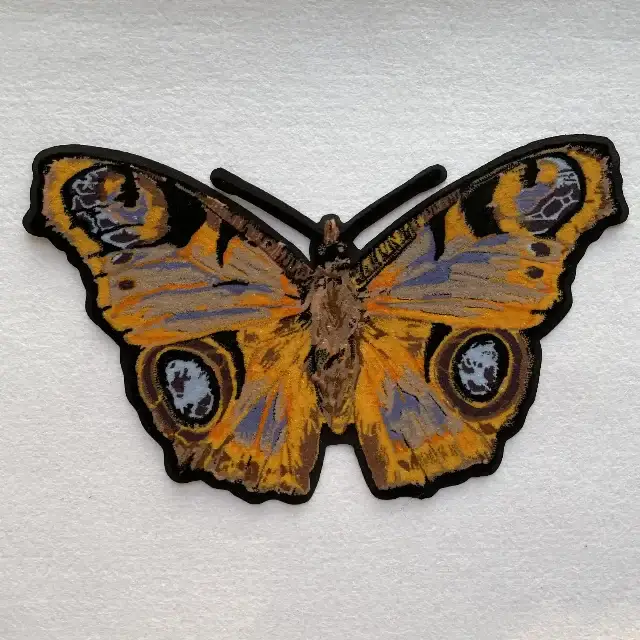
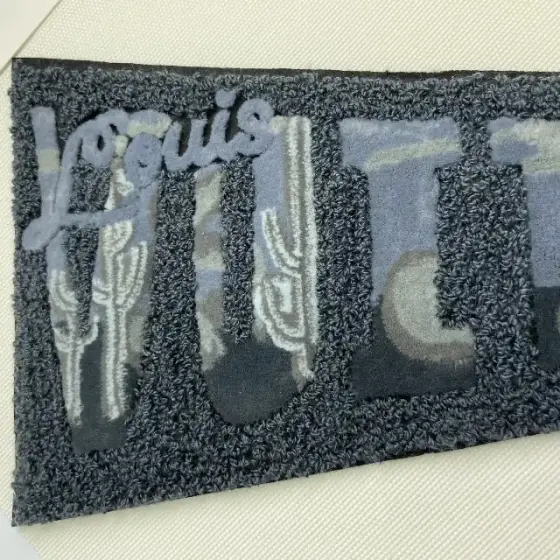
Combined techniques and more cases (8 examples)
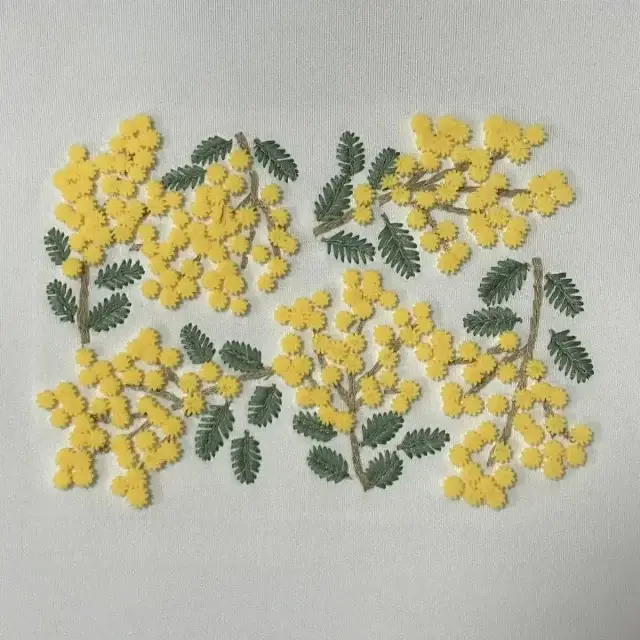
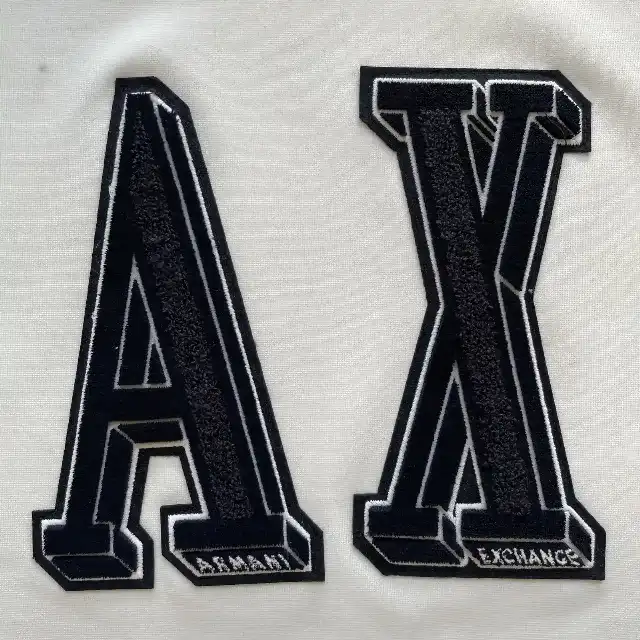
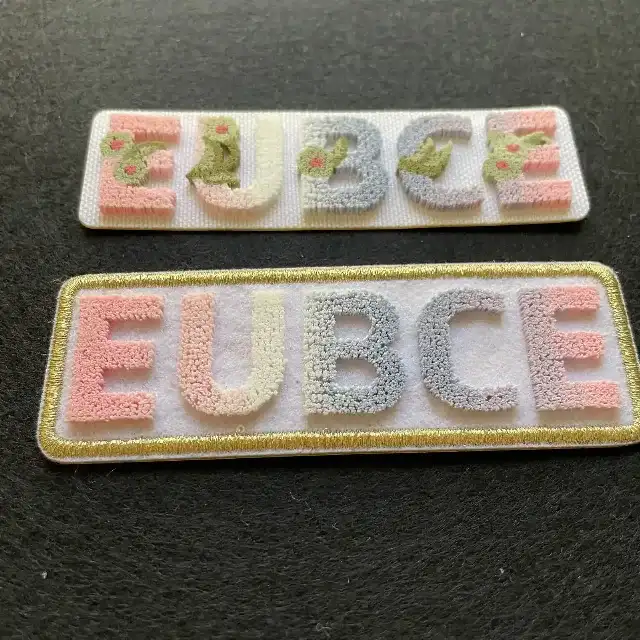
12. Contact us
Dongguan Dobest Industrial Co., Ltd. (Dobest) — founded in 2013, dedicated to computerised embroidery processing and special embroidery customisation, with toothbrush and chenille embroidery as its main focus, 30+ specialised computerised embroidery machines (including 15 dedicated toothbrush-embroidery machines) and a regular annual capacity of 1.5 million pieces . We support on-site meetings and fast sampling.
Phone / WeChat: 13712297700 | Website: dobest.hk | Enquire and request a sample online
Service area (on-site support across the Pearl River Delta)
We can meet customers on site in Dongguan, Shenzhen, Foshan (including Shunde), Zhongshan, Guangzhou, Zhuhai, Huizhou and Jiangmen; in Guangzhou city and its surroundings (Haizhu, Liwan, Tianhe, Baiyun, Huangpu, Panyu, Huadu, Nansha, Conghua, Zengcheng) and in Dongguan itself (Humen, Houjie, Chang'an, Dalang, Changping, Dalingshan, Shipai, Chashan, Tangxia, Liaobu, Dongcheng, Nancheng, Wanjiang and other towns), we can usually arrive within half a day. Clients outside the region and overseas can send samples by courier and get them returned.
For a sampling enquiry, please send: ① the artwork file ② the product or fabric it is for ③ the desired pile height and hand feel ④ the quantity and lead time — with all four, we can quote and sample quickly.

 2/F, Bldg E, Jinmao Xincheng, No.7 Jiedong South Rd, Xiaojiejiao, Humen, Dongguan, Guangdong, China
 mclau@dobest.hk