

 You are here:
 Product introduction
 All Products
 Embroidery Guides
- What Is Toothbrush Embroidery? Principle
- What Is Chenille Embroidery? Principles,
- What Is Cord Embroidery or Ribbon Embroi
- What Is Laser-Cut Embroidery / Openwork
- What is bead and beading machine embroid
- Sequin & Spangle Embroidery: What Is
- What Is Wool-Thread Embroidery? Process
- What Is Backing-Free Embroidery? Process
- What Is Tassel Embroidery? Process Princ
- What Is Cross-Stitch Embroidery? Techniq
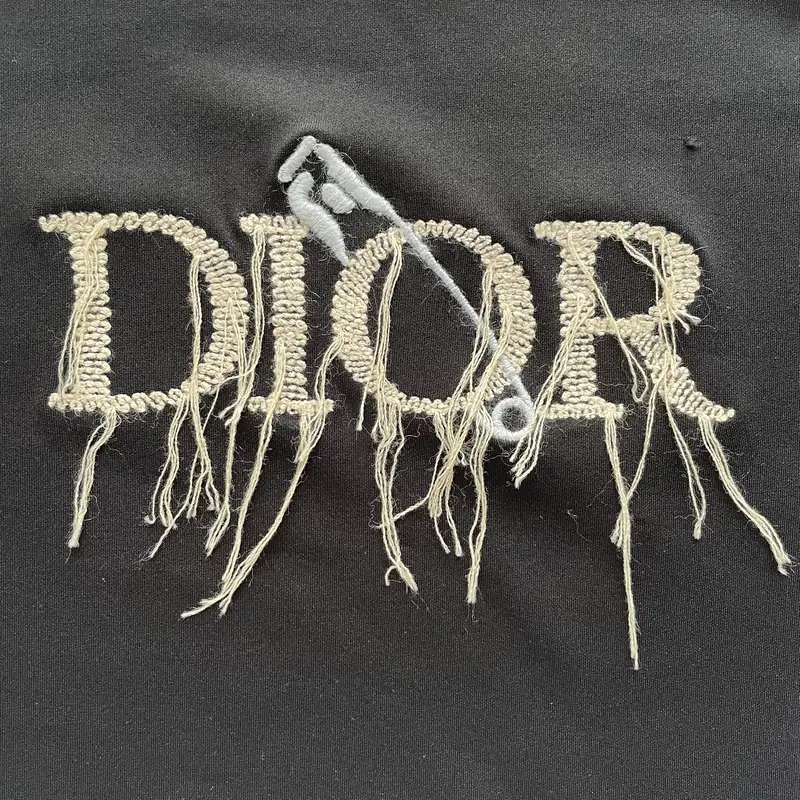
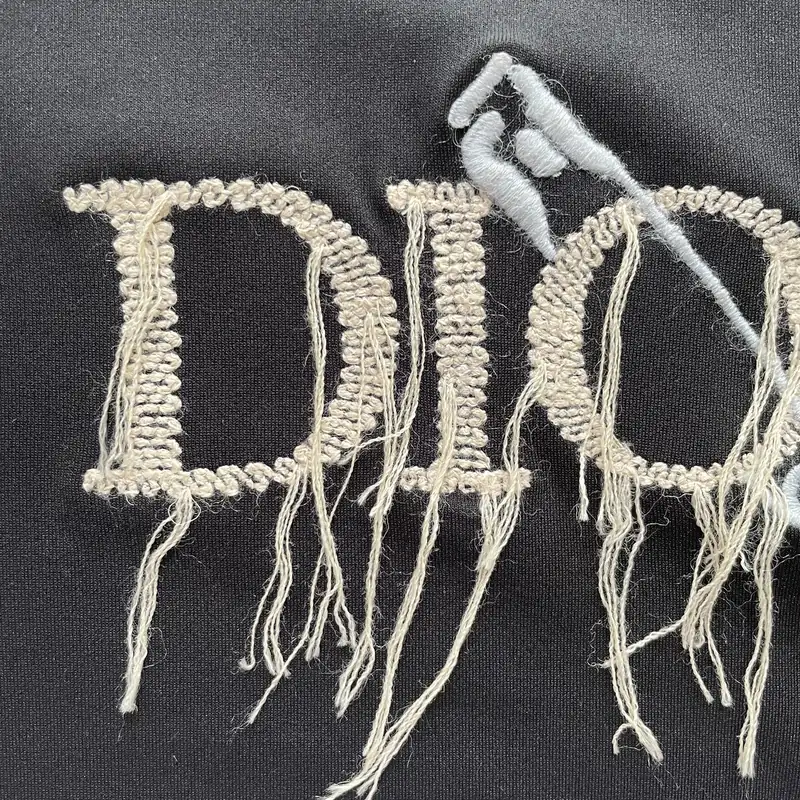
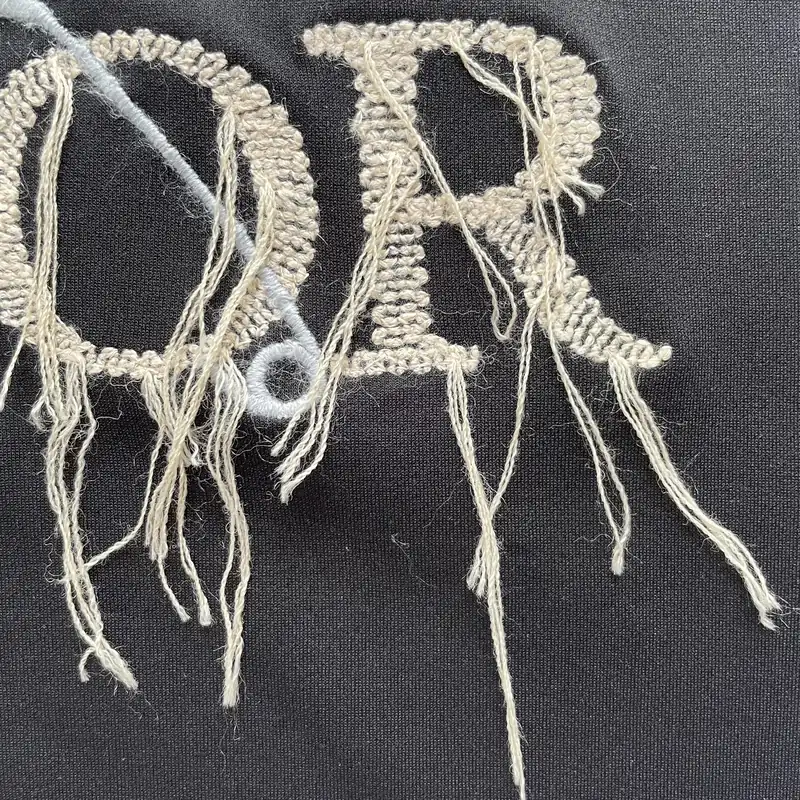
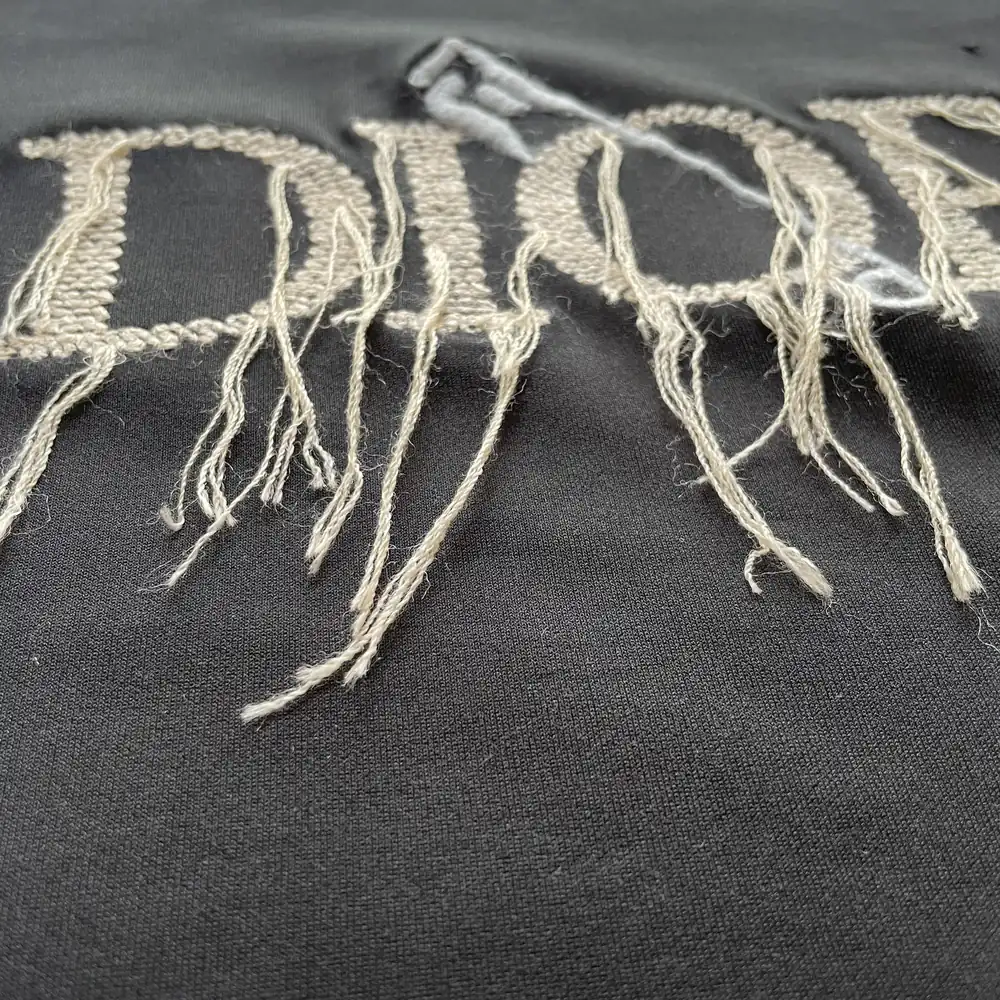
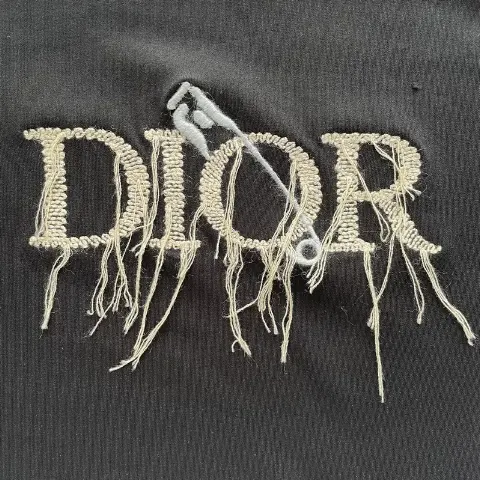
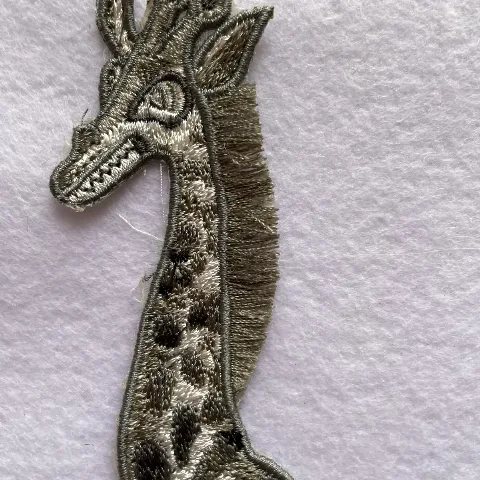
Distressed loose-end tassel embroidery features wool-thread embroidered letters as the main element: first, the embroidery thread is laid along the direction of the strokes to form a crisp, well-defined outline with uniform thickness and a full, raised profile; then a separate tassel base line is embroidered along the edge, and the loops are cut open so the ends fall into fringe. The wool thread has low twist and high loft, giving the letters a dimensional, substantial feel; the loose ends retain the filament texture after cutting and carry a slightly distressed look. The fringe ends sway with movement, adding a sense of motion to the flat embroidered patch.
Optional techniques
Different methods can be selected according to effect and application: for a clean outline, wool-thread flat embroidery can be used as the base with short loose ends; for fuller movement, the loose ends can be lengthened and the tassel roots made denser; for a softer drape, rayon or polyester thread can be used; for a rounder, more wear-resistant edge, closed-loop rounded tassels can be used. Thread materials and colourways for the letters can be adjusted according to your artwork.
Applications
Commonly used for chest and sleeve-side decoration on streetwear hoodies, denim jackets, and baseball caps, and also as accents on backpacks, waist bags, lanyards, and other accessories. The distressed loose-end look suits streetwear, vintage, and music-festival styles, and also works well as an identifying element for limited-edition apparel.
Customisation process
Customisation from artwork or sample is supported. Standard MOQ: 300 pieces; free sampling for 3 simple designs; sampling fees apply for complex or combined techniques (deductible from the order once the MOQ is reached); standard samples are produced in 24–48 hours, while complex or combined techniques take approximately 3–4 working days; standard bulk production lead time is 5–10 working days, subject to production scheduling confirmation, and rush orders can be prioritised in scheduling.
Production capacity
Dobest has more than 30 in-house computerised embroidery machines for specialty embroidery, a factory area of 3,000 m², and an annual capacity of approximately 1.5 million pieces, and can handle large-volume and multi-batch repeat orders. Tassel orders are completed through machine embroidery combined with manual trimming, bundle separation, and shaping. Before shipment, tassel roots are checked bundle by bundle for firmness, and goods are shipped flat-packed or roll-packed as agreed.
| Specification | Dobest manufacturing standard |
|---|---|
| Craft & aliases | Tassel embroidery (fringe / bullion fringe / hanging tassel)(Read the full craft guide) |
| Core specifications | Standard tassel length 10–50 mm, customisable; viscose, polyester, cotton and metallic-lustre threads |
| Size & stitch calculation | Quoted from your artwork (AI / PDF / CDR / high-resolution image) or a physical sample at full stitch density; available as direct panel stitching or stand-alone patches (hot-melt adhesive / hook-and-loop / sew-on edge) |
| Fabrics & applications | Guochao apparel, dress hems, shawls and scarves, cushion trims, cultural-creative pendants |
| Locking & wash resistance | High-density double-row lock stitching at the root + precision end trimming; fluid drape that resists shedding when pulled |
| Materials & audit credentials | Coats, Sakura and recycled eco yarns (raw materials supplied with OEKO-TEX® and SGS test reports from our suppliers); factory audited under Disney ILS and adidas SEA, with an internal defect rate below 1% |
| MOQ, lead time & capacity | MOQ 300 pcs; 3 free simple samples (24–48 h for standard, 3–4 working days for complex constructions); bulk lead time 5–10 working days; regular annual capacity 1.5 million pcs (up to 20,000 pcs/day at peak with full day-and-night shifts, subject to evaluation) |
 View All

Product Inquiry

 2/F, Bldg E, Jinmao Xincheng, No.7 Jiedong South Rd, Xiaojiejiao, Humen, Dongguan, Guangdong, China
 mclau@dobest.hk